
Did you know that cleaning disputes remain the primary reason for deposit deductions in the UK, often costing tenants hundreds of pounds? It's a frustrating reality that even a well-kept home can fail a final inspection if it doesn't meet the rigorous standards expected by landlords and letting agents. We understand the sheer scale of deep cleaning an entire property whilst trying to organise a move. To help you manage this transition without the stress of financial loss, we've developed this comprehensive end of tenancy cleaning checklist for 2026.
We agree that the difference between fair wear and tear and actual dirt can feel like a moving target, especially when your security deposit is on the line. This guide promises a meticulous, room-by-room breakdown of exactly what inspectors look for, from professional-grade oven restoration to the deep decontamination of carpets. By following our expert methodology, you'll gain a clear understanding of the standards required to secure a signed-off inventory report. We will preview the essential tasks for every living space, ensuring you approach moving day with the confidence of a professional and the peace of mind that your money is safe.
Key Takeaways
- Understand the professional standards expected by landlords in 2026 so you don't face unexpected financial deductions.
- Follow a detailed room-by-room end of tenancy cleaning checklist to systematically address high-scrutiny areas like kitchens and bathrooms.
- Learn why domestic products often fail the "oven test" and when it's best to use industrial-grade restoration for carbonised grease.
- Master the documentation process by aligning your cleaning efforts with the original inventory report and capturing date-stamped photographic evidence.
- Discover how fixed-fee services and military march-out standards provide total budget certainty for a stress-free move.
Understanding the Standard: Why a Checklist is Essential for Deposit Returns
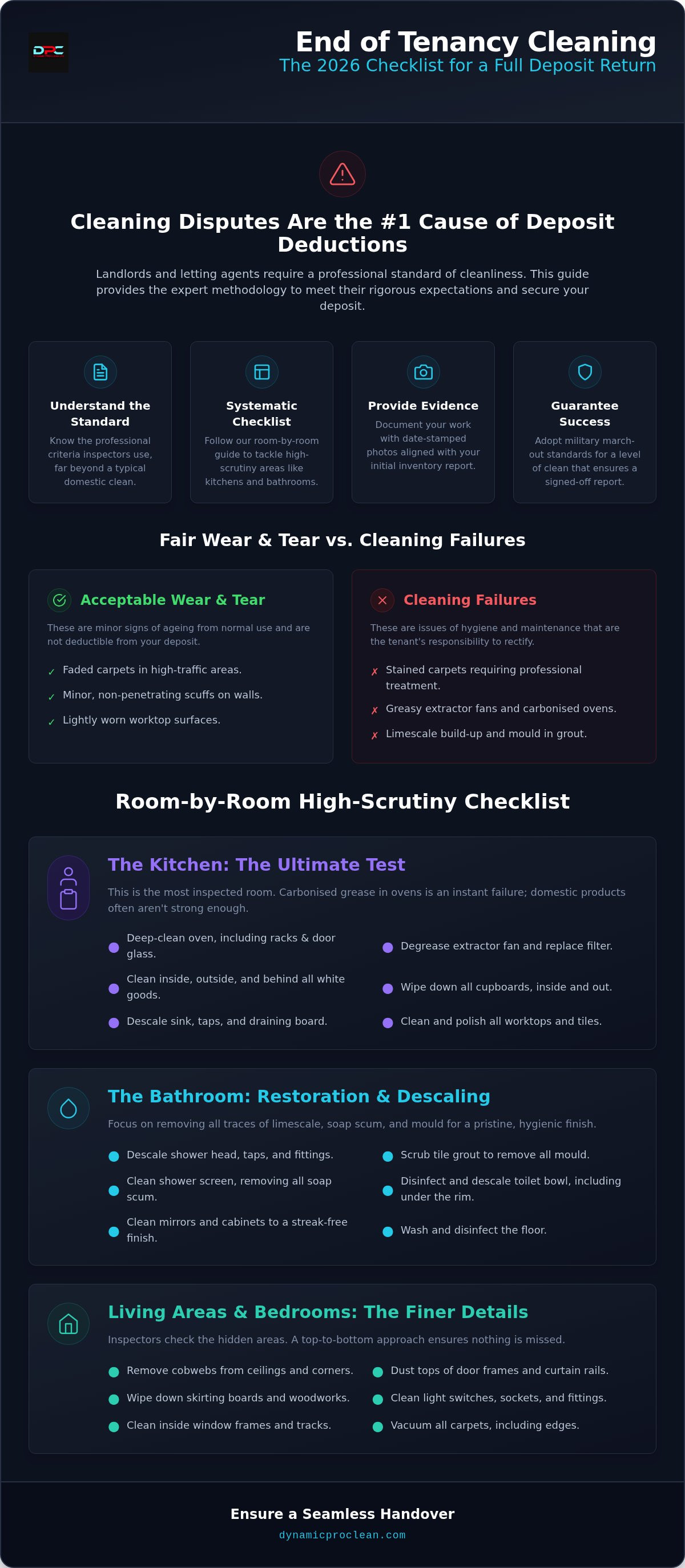
Returning a property involves more than just a quick vacuum and a wipe of the surfaces. In 2026, the "professional standard" required by most tenancy agreements refers to a level of cleanliness that matches a property's condition at the start of the lease, minus fair wear and tear. Landlords and inventory clerks often employ a "white glove" test, checking the hidden areas that daily cleaning routines usually miss. Using a structured end of tenancy cleaning checklist ensures you don't overlook these critical zones, such as the tops of door frames or the tracks of sliding windows.
The Deposit Protection Service (DPS) remains the arbiter for thousands of disputes each year, and the vast majority of these stem from cleaning omissions rather than actual damage. It's vital to distinguish between fair wear and tear, like a slightly faded carpet in a high-traffic hallway, and a cleaning failure, such as a stained carpet that hasn't been professionally treated. We've found that adopting military march-out standards, the most rigorous inspection criteria in the UK, is the only way to guarantee a pass. This level of detail transforms "clean" into "restored," which is exactly what your landlord expects to see before they sign off on your refund.
The Legal Obligation of the Tenant
Your tenancy agreement is a binding contract that likely contains specific clauses regarding the property's condition upon exit. Whilst the law prevents landlords from forcing you to use a specific cleaning company, it doesn't exempt you from reaching a professional result. You're legally obliged to return the home in its original state as documented in your initial inventory report. If that report describes the oven as "professionally cleaned," then a domestic scrub simply won't suffice. A checklist acts as your roadmap, aligning your efforts with the legal expectations set out in your contract.
The Financial Impact of Cleaning Disputes
Cleaning remains the most common reason for deposit deductions in the UK. When a landlord identifies a failure, they don't just charge for a bottle of bleach; they often calculate "pro-rata" charges based on the cost of hiring a specialist to rectify the issue. This can turn a missed skirting board or a greasy extractor fan into a deduction of hundreds of pounds. Beyond the money, providing a pristine property offers a psychological advantage. When an inventory clerk walks into a house that smells fresh and looks immaculate, they're naturally less inclined to scrutinise every minor scuff. It sets a tone of care that makes the entire handover process smoother for everyone involved.
The Room-by-Room Breakdown: A Comprehensive Cleaning Checklist
Approaching a move-out clean without a structured plan is a recipe for exhaustion and missed spots. A professional end of tenancy cleaning checklist allows you to tackle the property systematically, ensuring you meet the rigorous expectations of 2026 inventory clerks. We recommend starting with the most difficult rooms first to maintain your energy levels for the finer details later on.
The Kitchen Deep Clean Protocol
The kitchen is the most scrutinised room in any inspection. Beyond the obvious worktops, you must degrease the extractor fan and replace the filter if it's saturated. White goods require attention inside, on top, and even behind where dust bunnies gather. Ovens present the toughest challenge because removing carbonised grease requires more than domestic sprays. Every shelf and hinge must be free of crumbs and grease residue to pass inspection. If the buildup is significant, our guaranteed end of tenancy cleaning includes the heavy-duty restoration needed to pass the most stringent "oven test."
Bathroom Restoration and Descaling
Limescale and mould are the primary reasons bathrooms fail inspections. You'll need to polish all chrome fittings to a mirror finish, ensuring there aren't any water spots or dull residues left behind. Scrub the grout lines until every trace of pink or black mould is gone. Soap scum on glass screens and wall tiles must be completely dissolved. Finally, ensure the toilets are descaled even below the waterline; inspectors will check the very bottom of the bowl for any brown staining or calcification.
General Living Spaces and Hallways
Living areas often look clean at a glance but fail on the details. Dust the property from the top down, starting with ceiling cobwebs and the tops of curtain rails. Wipe down light switches and sockets to remove finger marks. Skirting boards are a magnet for dust and need a damp wipe to look their best. When vacuuming, pay close attention to the edges of the carpets where dust accumulates in a visible line. Don't forget the "hidden" areas like the tops of door frames and the dusty gaps behind radiators.
Professional vs DIY: When to Call in the Specialists
Deciding whether to tackle the final scrub yourself or hire an expert is often a matter of balancing time against financial risk. Whilst a domestic end of tenancy cleaning checklist provides a solid foundation, some tasks require industrial-grade power to meet a landlord's approval. Domestic products, though fine for weekly maintenance, often lack the chemical strength to dissolve years of accumulated lime or grease. If you miss even one area, like the carbonised residue inside an appliance, you risk losing a significant portion of your deposit to administrative and cleaning fees.
The Complexity of Professional Oven Cleaning
Supermarket sprays promise a lot but rarely deliver the deep decontamination required for a successful handover. These caustic foams often leave a sticky residue or fail to touch the hardened carbon on the back panel. We use specialised dip-tank methods that involve removing the racks and soaking them in non-toxic solutions to restore them to their original state. Crucially, we also clean between the glass panels of the oven door where grease drips and stays visible to any inspector. For a deeper look at why this appliance is so critical, see The Comprehensive Guide to Professional Oven Cleaning in the UK (2026).
Carpet and Upholstery Standards
Many tenants try to save money by hiring a rental carpet machine from a local store. However, these consumer-grade units often lack the suction power to remove the water they inject, leaving carpets damp for days and risking mould growth. Professional hot water extraction can remove allergens and deep-seated grit that domestic vacuums cannot reach. This process doesn't just clean the surface; it restores the pile and neutralises odours that have settled into the fibres. High-traffic areas like hallways and stairs often require specific stain removal techniques that domestic shampoos simply cannot handle without damaging the carpet's integrity.
Choosing a professional service also provides a "Cleaning Guarantee," which acts as your deposit insurance. If an inventory clerk finds a single fault, a reputable specialist will return to rectify it at no extra cost. This level of accountability provides total peace of mind whilst you focus on the logistics of moving into your new home. It's about moving forward with confidence, knowing that the standard of your previous property is beyond reproach.
Managing the Move-Out Process: Inventory, Documentation, and Timelines
Success on moving day depends on your ability to prove the property's condition just as much as the cleaning itself. While the physical labour is vital, the administrative side of a handover often determines whether a deposit is returned in full or becomes the subject of a lengthy dispute. Integrating your original check-in report with your end of tenancy cleaning checklist ensures no discrepancies arise during the final walk-through with your landlord or letting agent.
The Check-Out Inventory Matching
Your original check-in inventory is the most valuable tool you possess. It acts as a baseline, documenting every scuff, mark, and level of cleanliness present when you first received the keys. As you work through the property, cross-reference every item on that list with its current state. If a room was described as "professionally cleaned" at the start, it must be returned in that exact condition. Conversely, if certain areas were marked as "poor" or "stained" when you moved in, you aren't legally required to improve them, though you must ensure they haven't deteriorated further.
A common mistake tenants make is leaving behind "donations" or rubbish. Whether it's half-used cleaning products, old curtains, or "useful" kitchen items, landlords view these as obstacles that require professional removal. Anything not listed on the original inventory must be cleared from the property. If the logistics of moving are becoming overwhelming, our guaranteed end of tenancy cleaning provides the professional documentation and standard of finish needed to secure your refund without the stress.
Move-Out Day Final Checks
Timing your final clean is a delicate balance. We recommend completing the deep clean the day before the inspection to allow dust to settle and to give yourself time for a final "last look" walk-through. During this final sweep, check that all windows are closed, bins are completely empty and washed, and no personal items are left in the back of high cupboards. This is also the moment to take your final meter readings for water, gas, and electricity.
Documentation is your primary defence against unfair deductions in 2026. Take high-resolution, date-stamped photographs of every room, specifically focusing on the high-scrutiny areas like the inside of the oven, the bathroom grout, and the condition of the carpets. If a landlord identifies an issue during the walk-through, stay calm and refer to your photographic evidence. Having a clear record of the property's state at the moment you handed over the keys makes it much harder for arbitrary charges to be upheld by the Deposit Protection Service.
Ensuring a Seamless Handover with Dynamic Pro Clean
Securing your deposit in 2026 doesn't have to be a gamble. While a DIY end of tenancy cleaning checklist is a helpful tool, the physical and emotional toll of a move often leaves little room for the meticulous detail required by modern letting agents. We founded Dynamic Pro Clean in 2016 to bridge this gap, providing a service that acts as genuine deposit insurance. By choosing a professional partner, you replace uncertainty with a guarantee that the property will be restored to its original inventory state.
Our approach is built on budget certainty. Moving house is a costly endeavour, and the last thing you need is a fluctuating quote or an unexpected deduction from your security deposit. We offer fixed-fee pricing for our guaranteed end of tenancy cleaning, ensuring you know exactly what the investment will be from the outset. This comprehensive package includes the heavy-duty restoration of ovens and carpets, meaning you don't have to coordinate multiple contractors on your final day.
Our Specialist Military March-Out Expertise
We take immense pride in our background as specialists in military march-out standards. Military inspections are famously the toughest in the UK, requiring a level of decontamination that goes far beyond standard domestic cleaning. We apply these exact, uncompromising standards to every civilian tenancy we handle. For those who want to understand the depth of our methodology, our guide on Professional House Cleaning: The Ultimate Guide to Deep Property Restoration explores how we achieve these results. It isn't just about tidying; it's about a systematic restoration of the property's surfaces to meet the most stringent inspection criteria.
Booking Your Guaranteed Move-Out Clean
Arranging your service is straightforward and designed to fit into your moving schedule. You can request a free, no-obligation quote through our website, allowing you to plan your budget with confidence. To get the best results, we ask that the property is fully cleared of personal belongings and rubbish before our team arrives. This allows us to reach every corner, from the back of cupboards to the skirting boards behind heavy furniture.
Once the work is complete, we provide a professional invoice that you can present to your landlord or agent. This document serves as proof of your commitment to the property's upkeep, often smoothing the path to a swift and full deposit return. We're here to handle the grime, so you can focus on your new beginning without the fear of financial loss or cleaning disputes.
Secure Your Security Deposit with Confidence
Moving house is a significant milestone, and you shouldn't let cleaning disputes overshadow your new beginning. We've explored how a meticulous end of tenancy cleaning checklist serves as your primary defence against deposit deductions, especially when it's aligned with your original inventory report. By focusing on high-scrutiny areas like the oven and carpets, you ensure the property meets the professional standards expected in 2026. This systematic approach doesn't just clear away dirt; it restores the property to its original state.
If the scale of deep cleaning feels overwhelming, we're here to help you transition with total peace of mind. Our team applies expert military march-out standards to every job, utilising professional-grade oven and carpet restoration equipment that domestic tools simply cannot match. With our fixed-fee pricing guarantee, you can manage your moving budget with certainty and avoid the stress of final inspections. You can book your professional end-of-tenancy clean with Dynamic Pro Clean today and leave the hard work to the specialists. You've done the hard part of packing; let us ensure your deposit returns home with you.
Frequently Asked Questions
Do I have to hire a professional cleaner at the end of my tenancy?
You aren't legally obliged to hire a professional cleaning company, but you're contractually required to return the property to the standard documented in your initial inventory. If your agreement states the home was "professionally cleaned" at the start, you must match that level of hygiene. Many tenants find that following a comprehensive end of tenancy cleaning checklist is difficult to execute alone, which is why they often seek expert help to avoid financial loss.
What is the difference between "clean" and "professional standard"?
A standard domestic clean usually focuses on surface-level tidying and visible areas. In contrast, a "professional standard" is a restorative process that involves deep decontamination of the entire property. This includes descaling taps, degreasing the hidden parts of an extractor fan, and removing all traces of carbon from an oven. It's the rigorous benchmark used by inventory clerks in 2026 to determine if a property is ready for a new tenant.
Can a landlord deduct money for "fair wear and tear"?
Landlords can't legally deduct money for fair wear and tear, which refers to the natural deterioration of a property through normal use. Examples include slightly worn carpet piles in hallways or minor scuffs on walls. However, they can and will deduct for cleaning omissions, such as dust on skirting boards or a dirty fridge. It's essential to distinguish between a property that is "aged" and one that is simply "dirty" during your 2026 inspection.
Is oven cleaning usually included in an end-of-tenancy clean?
Most comprehensive professional services include a deep oven clean as standard because it's the most common reason for inspection failure. We treat the oven as a priority, using industrial-grade dip tanks to remove carbonised grease from racks and glass. If you're tackling the move yourself, ensure your end of tenancy cleaning checklist specifically includes the internal walls, roof, and door seals of the cooker to satisfy the most stringent landlord requirements.
How long does a professional end-of-tenancy clean typically take?
The duration of a professional clean depends entirely on the size and condition of the property. A standard one-bedroom flat typically takes between three and five hours for a team of specialists to complete. A larger four-bedroom family home can require eight to twelve hours of intensive labour. This timeframe ensures every room is restored to a professional standard, allowing for the deep descaling and degreasing tasks that domestic routines often miss.
Should I clean the windows inside and out before moving out?
You should always clean the internal glass, frames, and sills of all windows to remove dust and finger marks. Whether you need to clean the exterior depends on your specific tenancy agreement and the accessibility of the glass. If you live in a ground-floor flat or a house, landlords generally expect the external glass to be clear. For high-rise apartments, internal cleaning is usually sufficient as exterior maintenance is typically handled by the building management.
What happens if the inventory clerk is not happy with the cleaning?
If an inventory clerk identifies cleaning failures, they'll document these in their final report. The landlord may then hire a professional cleaning team to rectify the issues and deduct the cost from your security deposit. To avoid this, we recommend being present for the inspection with your documentation ready. If you've used a professional service like ours, we'll return to the property to address any identified faults at no extra cost to you.
Can I do my own end-of-tenancy carpet cleaning?
You can attempt to clean carpets yourself using a rental machine, but these often lack the suction power of industrial equipment. This can leave carpets excessively wet, which risks shrinkage or the growth of mould. Professional hot water extraction is often a requirement in modern tenancy agreements for properties with pets or high-traffic areas. Using a specialist ensures that deep-seated grit and allergens are removed, providing a finish that domestic units cannot achieve.


