
A failed march out inspection can result in MOD re-charges exceeding £600, a financial blow that often hits just as you're trying to settle into a new posting. With the Defence Infrastructure Organisation (DIO) now enforcing a strict "Zero Defects" standard for 2026, the margin for error has never been smaller. Achieving the level of military housing inspection cleaning required to satisfy a high-lumen torch inspection is a significant challenge, especially when you're already juggling the logistical demands of a relocation.
We understand that distinguishing between fair wear and tear and a cleaning deficiency feels like a moving target whilst you're balancing service duties with family life. This guide will help you master the specific MOD standards outlined in the latest JSP 464 regulations, ensuring you secure a clean sheet on your inspection report. We'll explore the "Big Three" failure points, from carbon build-up in ovens to deep-cleaned carpets, and provide a tactical roadmap to help you avoid penalties and enjoy a seamless transition to your next home.
Key Takeaways
- Understand the updated JSP 464 regulations and the DIO’s "Zero Defects" policy to align your expectations with the rigorous 2026 inspection standards.
- Identify the "Big Three" failure points, specifically ovens, carpets, and lime-scale, where high-lumen torch inspections are most likely to uncover deficiencies.
- Learn how professional military housing inspection cleaning provides a fixed-fee solution to avoid the risk of service record notes and re-charges exceeding £600.
- Discover how to navigate the inspection process to address minor issues immediately, ensuring a smooth handover and a "Green" status on your report.
- Evaluate the benefits of specialist cleaning packages that include professional oven and carpet restoration to guarantee your home meets the "Move-In" standard.
Understanding MOD March Out Standards and DIO Expectations
A March Out represents the formal conclusion of your time in Service Family Accommodation (SFA). It's the critical handover point where the property is returned to the Defence Infrastructure Organisation (DIO). Unlike a standard private rental, where a "domestic clean" might suffice, the MOD operates on a "Move-In Standard" for the next service family. This means the property must be handed over in a condition that allows another family to move in immediately without any further restorative work. The DIO, alongside their appointed industry partners, conducts these inspections with a level of scrutiny that often catches families off guard.
The 2026 policy is defined by a "Zero Defects" approach. This isn't just about tidiness; it's about precision. Inspectors now frequently use high-lumen torches to check for carbon build-up in ovens and lime-scale in hidden crevices. Professional military housing inspection cleaning is specifically tailored to meet these rigorous criteria, focusing on restorative results rather than just surface-level aesthetics. Whilst the history of military barracks and family quarters has evolved from basic communal living to modern housing, the expectation of discipline and order remains a constant during the handover process.
Understanding the distinction between "fair wear and tear" and cleaning deficiencies is essential for managing your move. You won't be charged for the natural thinning of a carpet after years of use or scuffs on walls that haven't been painted in over four years. However, a stained carpet or a greasy extractor fan is classified as a cleaning failure. These deficiencies are entirely preventable but require a level of deep cleaning that goes far beyond a weekly routine.
The 2026 Inspection Framework
Current protocols across the UK prioritise absolute consistency. Inspectors follow a standardised checklist to ensure every service person is held to the same high benchmark. Your most valuable tool in this process is the pre-move-out appointment, which must be booked at least 30 working days before your departure. This advisory visit identifies specific problem areas, giving you a tactical window to address them before the final inspection. Ignoring the feedback from this visit is the most common reason for failure.
Why Military Inspections are Stricter Than Civilian Tenancies
The stakes of a failed inspection are significantly higher in a military context. A failure doesn't just mean a delayed deposit; it can disrupt your entire relocation timeline and result in re-charges exceeding £600. These costs are often deducted directly from your JPA account. Because the MOD must ensure the next family receives a home in pristine condition, they have no room for leniency. Using specialist military housing inspection cleaning ensures your home meets the "Move-In Standard," protecting your service record and your budget during a stressful transition.
Room-by-Room Military Housing Cleaning Requirements
Passing your march out requires a tactical approach to every square inch of the property. Effective military housing inspection cleaning isn't about a quick wipe; it's about restorative work that returns every surface to its original state. Inspectors will move through your home with a specific sequence in mind, and being prepared for their level of detail is the only way to ensure a first-time pass. Each room presents unique challenges that can easily lead to a deficiency if overlooked.
The Kitchen Deep Clean Checklist
The kitchen is arguably the highest-scrutiny room in any Service Family Accommodation. Grease is the inspector’s primary target, particularly on top of wall units, inside extractor fans, and behind heavy appliances. You must pull out the cooker, fridge, and washing machine to clean the floor and wall surfaces behind them. Every drawer and cupboard needs to be emptied and wiped down, paying close attention to the tracks and hinges where crumbs and dust accumulate. Don't forget to degrease the extractor filters or replace them entirely if they're saturated, as a sticky filter is an immediate red flag.
Bedrooms and Living Space Standards
In living areas and bedrooms, the focus shifts to dust and woodwork. High-level surfaces like curtain rails, the tops of picture rails, and light fittings are frequently missed during DIY cleans. Ensure you wipe down all architraves, skirting boards, and the very tops of doors. If your quarters include fitted wardrobes, these must be vacuumed and sanitised internally. Windows require attention both inside and out, including the frames and the internal sills. A common failure point is the buildup of dead insects or dust in the window tracks, so use a vacuum attachment to clear these thoroughly before wiping.
Bathrooms and external areas also demand significant effort. Limescale is the most common reason for bathroom failures, especially around taps, showerheads, and the "waterline" in toilets. All fixtures must be polished and free of soap scum or mould. Externally, garages must be swept, bins must be thoroughly washed and left empty, and the garden must be tidy with grass cut. Following the MOD/DIO guidance on move-out standards is vital to ensure no detail is missed. If the scale of this task feels overwhelming whilst you're managing a move, booking professional military march out cleaning can provide the expertise needed to hit these rigorous benchmarks without the stress.
Tackling the "Big Three" Inspection Failure Points
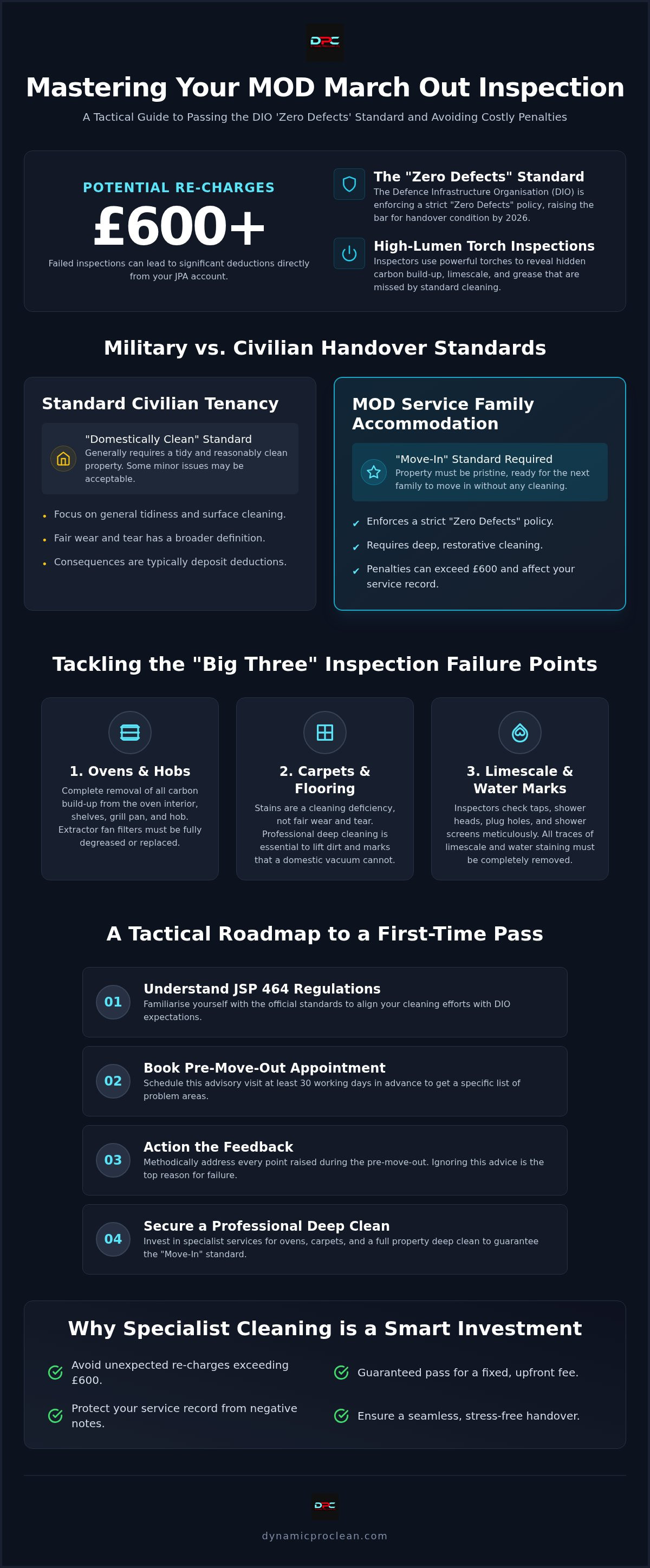
While every room in your quarters must be spotless, three specific areas account for the vast majority of failed handovers. Ovens, carpets, and lime-scale are the points where inspectors spend the most time because they are the hardest to restore to a "Move-In" standard. Achieving a successful military housing inspection cleaning result means moving beyond domestic tidiness and addressing these high-scrutiny zones with professional-grade techniques. Inspectors adhere strictly to the official MOD March Out standards, which require these items to be entirely free of residue, stains, and mineral deposits.
Professional Oven Restoration
The "White Glove" test is a reality during a march out. Inspectors aren't just looking at the hob; they'll check the internal fan housing, the roof of the oven, and the space between the glass door panes for carbonised grease. Supermarket sprays often fall short because they can't penetrate thick, burnt-on deposits and frequently leave a sticky chemical film that is itself a failure point. You must ensure that every rack, tray, and internal mechanism is restored to a polished finish. For a detailed breakdown of what this involves, you can read The Comprehensive Guide to Professional Oven Cleaning in the UK (2026).
Carpet and Upholstery Care
Standard vacuuming is never enough to pass a military inspection. High-traffic areas in hallways and living rooms accumulate deep-seated grit and allergens that only hot water extraction can remove. Inspectors will look for visible spotting and lingering odours, especially in homes with pets or young children. Whilst many families consider hiring a DIY carpet cleaner, these machines often lack the suction power of professional units, leaving carpets damp and prone to shrinkage or musty smells. Our guide on Professional House Cleaning: The Ultimate Guide to Deep Property Restoration explains why professional-grade extraction is the only way to guarantee a fresh finish that meets DIO expectations.
Lime-scale is the final hurdle, particularly in hard-water regions. It isn't enough to simply wipe down a tap; you must eradicate the crust from the underside of the spout and the base of the handles. Shower heads must be completely descaled so that every nozzle is clear. In the bathroom, the waterline and the rim of the toilet bowl must be free of any mineral staining. These details might seem minor, but they are the hallmark of a property that has been maintained with pride and professional care.
An "Amber" status indicates minor deficiencies. These are often small oversights that don't necessarily warrant a full failure but still fall short of the "Move-In Standard." If you're present during the inspection, you can often rectify these issues on the spot. Carrying a small cleaning kit with you during the walkthrough is a tactical move that can turn an Amber into a Green within minutes. However, a "Red" status represents a formal failure. This means the property requires a professional re-clean because the standard of military housing inspection cleaning was insufficient to meet the DIO's strict criteria.
Common Deficiencies and How to Avoid Them
Small details often signal a general lack of care to an inspector. Missing light bulbs, broken pull-cords, or dust on the very top of radiators are common reasons for an Amber status. Inspectors also pay close attention to ventilation grilles and the internal tracks of sliding doors, where dust can quickly accumulate. To ensure you haven't missed these easily overlooked spots, consult The Ultimate End of Tenancy Cleaning Checklist 2026: Secure Your Deposit. This resource provides a granular breakdown of the high-level areas that frequently cause issues during the final walkthrough.
What Happens If You Fail?
A "Red" status triggers a series of stressful and costly events. The MOD will typically appoint their own contractors to perform a professional re-clean, and the charges, which often exceed £600, are usually deducted directly from your JPA account. Beyond the financial impact, a failure can disrupt your entire relocation timeline. You may be required to attend a re-inspection, which is incredibly difficult to manage if your belongings are already in transit and you're expected at your new posting. To avoid these complications and ensure a smooth transition, many families choose to invest in guaranteed military march out cleaning that ensures a "Green" status on the first attempt.
Professional March Out Cleaning: Is It Worth the Investment?
Deciding whether to tackle the final clean yourself or hire a specialist is a pivotal moment in your relocation planning. Whilst the initial cost of professional military housing inspection cleaning might seem like an added expense, it's essential to weigh this against the potential for MOD re-charges and the sheer volume of labour required. A thorough march-out clean for a standard family home can easily consume three full days of intensive scrubbing. When you're already managing the logistics of a move and maintaining your service duties, finding that time without sacrificing your final days with neighbours and friends is a significant challenge.
The true value of a professional service lies in the mitigation of risk. As we've explored, the DIO standards for 2026 are uncompromising. A DIY attempt that misses carbon in the oven or lime-scale on a showerhead can lead to an immediate "Red" status and the financial penalties that follow. By choosing a specialist, you're investing in an "inspection-ready" result that aligns perfectly with the criteria used by Pinnacle and the DIO. This isn't just about surface appearances; it's about using industrial-grade equipment to achieve a restorative finish that domestic products simply cannot match.
The Benefits of a Specialist Approach
Professional cleaners bring more than just sponges and sprays to your quarters. They utilise high-powered hot water extraction units for carpets and specialised dip tanks for oven components, ensuring the "Big Three" failure points are handled with precision. This specialist approach also incorporates eco-friendly solutions that are safe for your family and pets whilst being tough enough to shift years of built-up grime. Most importantly, it grants you the peace of mind to focus on your new posting. Instead of spending your final hours in the property on your hands and knees, you can ensure your family's transition is as smooth and stress-free as possible.
Securing Your Relocation with Dynamic Pro Clean
At Dynamic Pro Clean, we've dedicated ourselves to the art of tenancy restoration since 2016. We understand the unique pressures faced by service families, which is why our military housing inspection cleaning packages are built around a transparent, fixed-fee structure. This eliminates the worry of budget creep and ensures that professional oven and carpet cleaning are always included as standard. We take immense pride in our craft, acting as your dedicated partner to ensure your home meets the rigorous "Move-In Standard" required for a successful handover. Request a free quote for your military march out clean today and let us handle the hard work, so you can move forward with confidence.
Secure a Seamless Transition to Your Next Posting
Passing a march out in 2026 requires more than just effort; it demands a tactical understanding of the DIO’s "Zero Defects" policy. By focusing your energy on the high-scrutiny failure points like ovens, carpets, and lime-scale, you can avoid the financial burden of re-charges and the logistical nightmare of a failed handover. Whether you're moving across the country or just to the next base, the goal remains a "Green" status that protects your service record and your family's peace of mind.
At Dynamic Pro Clean, we specialise in military housing inspection cleaning designed to meet these exact benchmarks. Our fixed-fee packages are tailored specifically for service families, ensuring specialist oven and carpet restoration are included as standard. We take immense pride in delivering a result that satisfies the most rigorous inspections, allowing you to focus entirely on the excitement of your new posting. Book your professional military march out clean with Dynamic Pro Clean today to guarantee an inspection-ready home. You've done the hard work of serving; let us handle the hard work of scrubbing. Good luck with your move.
Frequently Asked Questions
What is included in a military march out cleaning service?
A comprehensive military march out cleaning service includes a restorative deep clean of the entire property to meet "Move-In Standards." This covers every room, from degreasing kitchen surfaces and cupboards to descaling bathroom fixtures. Specialist packages from Dynamic Pro Clean include professional oven cleaning and carpet extraction as part of a fixed-fee service. We also ensure all woodwork, internal windows, and high-level surfaces like curtain rails are dust-free to satisfy the most rigorous inspectors.
How long does a professional march out clean typically take?
The duration depends on the size and condition of the property, but a thorough clean typically takes between one and two full days. For a three-bedroom family home, a team of specialists will often spend a minimum of eight hours on-site to ensure every detail meets the DIO benchmarks. We recommend allowing at least 48 hours before your inspection date to ensure the property is fully dry and ready for the final walkthrough.
Do I need to be present for the cleaning and the inspection?
You don't need to be present whilst the cleaning is taking place, as our teams are fully self-sufficient once granted access. However, we strongly advise being present for the final inspection with the Housing Officer. This allows you to address any minor "Amber" deficiencies immediately on the spot. If you've used a professional service, having the receipt ready provides documented evidence that the property has been restored to the required standard.
Can I clean the carpets myself using a hired machine?
Whilst you can hire a machine, DIY units often lack the suction power and heat required to remove deep-seated grit and allergens. Inspectors frequently look for evidence of professional carpet cleaning, especially in homes with pets. Using a hired machine can leave carpets over-saturated, leading to musty odours or shrinkage. Professional-grade extraction is the only way to guarantee the restorative finish required to pass a high-scrutiny military inspection without the risk of failure.
What happens if the inspector finds a deficiency after a professional clean?
If a deficiency is identified after a professional clean, a reputable provider will typically offer a guarantee to return and rectify the issue at no extra cost. This is why choosing a specialist with experience in military housing inspection cleaning is vital. At Dynamic Pro Clean, we aim for a "Zero Defects" report on the first attempt, but having that peace of mind ensures you won't face MOD re-charges if a minor detail is missed.
Is oven cleaning mandatory for a military housing inspection?
Oven cleaning is absolutely mandatory and is the most scrutinised area during a march out. The inspector will perform a "White Glove" test to check for carbonised grease on the racks, the roof of the oven, and behind the fan housing. A standard domestic clean is rarely sufficient to pass this test. Professional restoration is essential to ensure every component is entirely free of residue and restored to a polished, move-in condition.
How much does a military housing inspection clean cost?
The cost varies based on the number of bedrooms and the specific requirements of the property. For military families, we provide a fixed-fee structure to prevent budget creep during an already expensive relocation. This fee covers the entire property, including the specialist oven and carpet cleaning that often costs extra with civilian agencies. For an accurate quote for military housing inspection cleaning tailored to your quarters, we recommend requesting a free assessment through our website.
When should I book my march out cleaning service?
You should book your cleaning service as soon as you have your march out date, ideally at least 30 days in advance. This timeline aligns with the requirement to book your pre-move-out appointment with the Housing Officer. Securing your slot early ensures you have a professional team ready to work immediately after your furniture has been removed, providing a clear window for the property to be restored before the final inspection takes place.


