
The success of your carpet restoration is often decided long before our high-pressure extraction units even leave the van. It's a common misconception that the heavy lifting only starts when the technician arrives; in reality, the most impressive results are born from a seamless partnership between the homeowner and the specialist. We understand that inviting a professional into your home can feel slightly overwhelming, especially when you're unsure about moving heavy furniture alone or whether your pets will be safe during the process.
If you've spent time wondering how to prepare for professional carpet cleaning to get the best value for your investment, you aren't alone. This ultimate 2026 guide will show you exactly how to prepare your home to ensure your carpets receive the deepest possible restoration whilst maximising the efficiency of your appointment. We'll explore everything from clearing the floor to managing airflow for faster drying times, ensuring a stress-free experience that returns your house to normal as quickly as possible. By following these professional steps, you'll help us focus on what we do best: delivering a revitalised, pristine finish that meets even the strictest inspection standards.
Key Takeaways
- Secure a parking space as close to your entrance as possible to accommodate the heavy, professional-grade extraction equipment required for a deep clean.
- Discover exactly how to prepare for professional carpet cleaning by clearing small items and identifying which furniture pieces require relocation for total floor coverage.
- Learn why pre-cleaning tasks like dusting skirting boards and professional-standard vacuuming are essential to prevent secondary soiling during the wet cleaning process.
- Create a dedicated safety plan for children and pets to manage the risks of trailing hoses and slippery floor transitions whilst the technician is working.
- Understand how to conduct a final walk-through to ensure your property meets the strict restoration standards required for landlord or military march-out inspections.
Managing Logistics and Access for Your Cleaning Technician
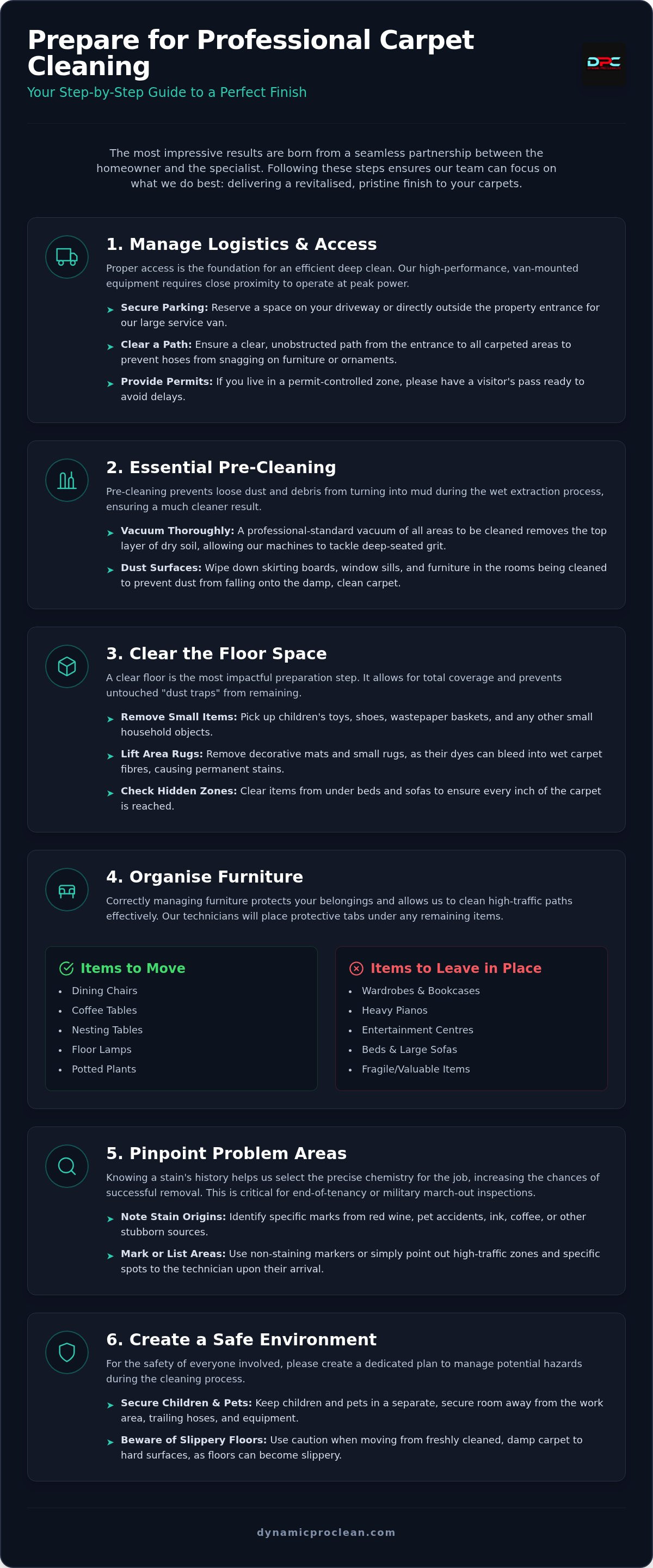
Professional preparation is the foundation of any successful deep restoration. When you understand how to prepare for professional carpet cleaning, you aren't just tidying up; you're ensuring our high-performance machinery can operate at peak efficiency. Most homeowners overlook the logistics of the service vehicle itself. Our industrial-grade equipment, often utilising advanced carpet cleaning methods like hot water extraction, requires significant power and proximity. If we're using a van-mounted system, the distance from the vehicle to your furthest room dictates the heat and pressure we can maintain. A shorter hose run means a deeper, more consistent clean for your carpet fibres.
Securing Parking and Property Access
Finding a suitable spot for a large service van in the UK can be a logistical challenge. Please ensure there's a cleared space on your driveway or a reserved spot directly outside the property entrance. If you live in a permit-controlled zone, having a visitor's pass ready is essential to avoid appointment delays. It's also a thoughtful gesture to notify neighbours if our van might temporarily block a shared access point or a narrow lane amongst other parked vehicles. Beyond parking, we need a clear "path of least resistance" from your front door to the furthest carpeted area. This prevents heavy hoses from snagging on delicate ornaments or hallway furniture. Access to an external water tap or a specific internal drainage point is also vital for the waste water disposal required by modern environmental regulations. If you cannot be present, please arrange key collection or provide a secure lockbox code in advance.
Identifying and Marking Problem Areas
Every stain has a story, and knowing that story helps us choose the right chemistry for the job. Before we arrive, take a moment to note the origin of specific marks, whether they are old red wine spills, recent pet accidents, or stubborn ink leaks. Knowing the "stain history" allows our technicians to select the precise neutralising agent needed for that specific fibre type. You don't need to move every heavy wardrobe, but using small, non-staining markers or keeping a simple list of high-traffic zones ensures we prioritise the areas that matter most to you. This level of detail is especially critical for military march out cleaning or end-of-tenancy cleans, where meeting strict inspection standards is the primary goal. Knowing how to prepare for professional carpet cleaning ensures we spend our time on restoration rather than guesswork.
Clearing the Floor and Organising Furniture Removal
Clearing the floor is the most impactful step when considering how to prepare for professional carpet cleaning. A technician's time is best spent treating deep-seated grit and stains, not navigating household clutter. Begin by removing all small items: children’s toys, shoes, and wastepaper baskets. It's particularly important to address the "hidden" zones. Items tucked under beds, sofas, or behind curtains often block the reach of the extraction wand, leaving untouched dust traps behind. We also recommend lifting all small area rugs and decorative mats. These often feature unstable dyes that can cause permanent colour bleed into the wet carpet fibres underneath during the restoration and drying phases.
The Furniture Rule of Thumb
As a general guide, if an item requires two people to lift it or is structurally fragile, it usually stays in place. Wardrobes, heavy pianos, and fully laden bookcases are left undisturbed to prevent damage to both the furniture and the carpet backing. However, we ask homeowners to organise the removal of dining chairs, coffee tables, nesting tables, and floor lamps to a non-carpeted area. This allows for total coverage of high-traffic paths where soil builds up most. For the items that remain, we utilise protective foil tabs or plastic blocks. These prevent moisture from wicking into wooden legs and stop furniture stains from seeping into damp fibres, a standard practice aligned with Carpet and Rug Institute guidelines for professional maintenance.
Removing Fragile and Valuable Items
Liability and safety are our top priorities during any deep clean. Please remove all breakables, such as vases, porcelain ornaments, or picture frames, from the tops of any furniture that might be shifted slightly for access. Electronics, computer towers, and trailing cables should be coiled and stored safely off the floor. A clear, hazard-free environment lets the technician focus entirely on the restoration process without the worry of accidental damage. If you're unsure about specific heavy pieces or need a hand with the logistics, our professional carpet and upholstery cleaning team can provide guidance during the initial site assessment. By clearing the stage, you ensure every square inch of your flooring receives the attention it deserves.
Essential Surface Preparation and Pre-Cleaning Tasks
Once the floor is clear of furniture and clutter, the focus shifts to the carpet surface itself. Many homeowners ask whether they should vacuum before we arrive, and the answer is a resounding yes. Whilst professional-grade equipment is incredibly powerful, removing the bulk of dry soil beforehand is a critical part of how to prepare for professional carpet cleaning. If dry dust and grit aren't removed, the introduction of hot water can turn that debris into a fine "mud" deep within the backing. This makes the extraction process more labour-intensive and can lead to longer drying times. We recommend using a high-quality vacuum with a crevice tool to get right into the edges where the carpet meets the wall. This ensures the technician can spend their time on deep steam restoration rather than basic surface maintenance.
The Importance of a Pre-Clean Vacuum
Research suggests that up to 80% of carpet soil is dry particulate matter. By vacuuming thoroughly, you are removing the abrasive grit that acts like sandpaper against the delicate fibres during the cleaning process. Pay particular attention to high-traffic zones and the areas where pets like to lounge. Using a crevice tool along the perimeter is essential; it prevents the "filtration soiling" lines that often accumulate where air moves through the gap between the carpet and the skirting board. Taking these extra minutes to vacuum is a vital part of how to prepare for professional carpet cleaning, as it preserves the integrity of the pile and allows our solutions to penetrate deeper into the remaining oily soils.
Dusting Skirting Boards and Pinning Curtains
Dusting your skirting boards is perhaps the most overlooked preparation task. When carpets are cleaned using hot water extraction, the fibres remain damp for several hours. If the skirting boards are dusty, the moisture can actually "wick" that dirt directly into the freshly cleaned edges of the carpet. This often results in unsightly grey lines that are difficult to remove once the carpet has dried. A quick wipe down with a damp cloth or a static duster prevents this transfer of soil.
Floor-length curtains and drapes also require attention before the technician arrives. To ensure we can achieve edge-to-edge cleaning without damaging your window treatments, these should be pinned up at least six inches off the floor. You can use large safety pins or clothes pegs to secure them. This protects the fabric from becoming damp and prevents any unstable dyes in the curtain material from bleeding into your wet carpet. If you are following our end of tenancy cleaning checklist to secure a deposit, you'll know that landlords pay close attention to these perimeter details during the final inspection. These simple preparatory steps ensure a flawless finish that meets the highest professional standards.
Ensuring a Safe Environment for Children, Pets, and Delicate Items
Safety is a paramount consideration that extends beyond the protection of your flooring. When you are learning how to prepare for professional carpet cleaning, you must account for the physical presence of industrial machinery. Professional restoration involves high-pressure trailing hoses and heavy electrical cables that run from our service vehicle into your home. These represent significant trip hazards for anyone moving through the property. Perhaps the most overlooked danger is the "slip hazard" transition. Walking from a damp, freshly treated carpet onto a hard surface like tile, laminate, or wood is remarkably similar to stepping onto ice. We advise all residents to remain in non-carpeted areas or wear rubber-soled indoor shoes until the fibres are completely dry.
Pet and Child Safety Protocols
The noise and activity of a deep clean can be distressing for domestic animals. To reduce their stress and ensure their safety, we recommend keeping pets in a separate, quiet room or off-site entirely for the duration of the appointment. This prevents them from escaping through the slightly ajar doors required for hose access or treading on wet carpets, which could track moisture back onto hard floors. For households with curious toddlers, child gates are an excellent tool to keep them away from the work zone and industrial equipment. Whilst all our cleaning solutions comply with the August 2026 GB Mandatory Classification and Labelling (GB MCL) standards for safety, direct contact with damp fibres should be avoided until the drying process is complete.
Atmospheric Preparation for Faster Drying
A proactive approach to your home's atmosphere can significantly reduce drying times, which is a vital part of how to prepare for professional carpet cleaning. By 2026, industrial hot water extraction has become incredibly efficient, but evaporation still relies on airflow and temperature. We suggest setting your thermostat to a consistent 20 to 22°C before our arrival. This provides the ideal thermal energy for moisture to leave the carpet pile. If the external humidity is low, opening windows can create a cross-breeze that speeds up the process; however, if it's raining or particularly humid outside, it's better to keep them closed and rely on internal climate control. If you have ceiling fans or portable air movers, positioning them to circulate air across the floor beforehand will help your house return to normal much faster.
If you have concerns about specific delicate items or want to ensure your home environment is perfectly managed for a deep restoration, our professional carpet and upholstery cleaning specialists are always available to provide bespoke advice. Taking these atmospheric and safety steps ensures the cleaning day is as efficient and stress-free as possible.
Post-Clean Readiness and Meeting Professional Inspection Standards
The completion of the extraction process marks the transition into the most critical stage of the service: the drying phase. Whilst the heavy machinery has been packed away, the restoration is not truly finished until the fibres are bone dry. Understanding how to prepare for professional carpet cleaning involves planning for this post-clean period to ensure the results remain pristine. A typical walk-through with your technician at the end of the appointment allows you to review high-traffic areas and discuss any stubborn stains that required specialist neutralising agents. This is also the moment to confirm that the work meets the rigorous criteria often found in tenancy agreements.
For those vacating a property, meeting specific standards for military march out cleaning or private landlord inspections is vital. These inspections are notoriously strict, often requiring proof that the carpets have been professionally restored rather than just vacuumed. Taking these steps is a vital part of how to prepare for professional carpet cleaning, as it ensures the transition from a work site back to a comfortable home is seamless.
Preparing for the Final Inspection
We recommend having your tenancy agreement or specific inspection checklist ready for the technician to review before they finish. A professional carpet cleaner will provide a formal receipt or certificate of service, which serves as essential evidence for your deposit return. During the walk-through, look closely at the edges and corners. You should also be aware of "wicking," a phenomenon where deep-seated stains occasionally travel up the fibre as it dries. If this occurs, a reputable specialist will advise on the next steps to ensure the finish remains flawless for your handover.
The First 24 Hours: Aftercare Logistics
The first day following a deep clean is when the carpet is most vulnerable to re-soiling. Walking on damp fibres with outdoor shoes will immediately transfer dirt and oils back into the pile, undoing the restoration work. We suggest keeping a pair of clean white socks or indoor slippers handy for any essential movement through the house. It is also vital that you do not replace heavy furniture or remove the protective foil tabs until the carpet is completely dry, which typically takes between 4 to 12 hours depending on the ventilation steps discussed in the previous section. Replacing wooden or metal furniture legs onto damp carpet can cause permanent rust or varnish stains that are nearly impossible to remove. By respecting these aftercare logistics, you protect your investment and ensure your home returns to normal with a truly professional result.
Achieving a Flawless Finish for Your Home
A successful deep restoration is a shared effort between the homeowner and the technician. By understanding the logistics of van access and the necessity of clearing high-traffic paths, you allow our specialists to focus entirely on the science of stain removal. We've explored how a simple pre-clean vacuum and proactive atmospheric control can drastically reduce drying times, ensuring your property returns to normal as quickly as possible. This guide has provided the definitive roadmap for how to prepare for professional carpet cleaning to ensure every fibre is revitalised to the highest possible standard.
Since 2016, Dynamic Pro Clean has been a trusted partner for homeowners and military personnel alike. We specialise in meeting strict military march-out standards and offer a comprehensive fixed-fee service with no hidden costs. Whether you're preparing for a landlord inspection or simply refreshing your family living space, our expert team is here to handle the heavy lifting with professional pride. Book your professional carpet restoration with Dynamic Pro Clean today and experience the peace of mind that comes with a truly seasoned specialist. Your carpets are in safe hands.
Frequently Asked Questions
Should I vacuum my carpets before the professional cleaners arrive?
Yes, you should vacuum thoroughly before we arrive. Removing the bulk of dry particulate matter beforehand is a key part of how to prepare for professional carpet cleaning. This prevents abrasive grit from turning into a sludge when hot water is introduced. By clearing the surface dust yourself, you ensure our technician spends every minute of their visit on deep-seated restoration rather than basic surface maintenance.
How long do I need to wait for my carpets to dry after a deep clean?
Most carpets will be touch-dry within 4 to 12 hours. This timeframe varies based on the pile depth, the level of soiling, and the ambient humidity in your home. Industrial hot water extraction equipment in 2026 is designed for high-efficiency moisture recovery. To ensure the fastest results, keep the heating at a steady temperature and maintain good airflow throughout the property until the fibres are bone dry.
Do I need to move all the heavy furniture out of the room myself?
You don't need to move everything, but clearing the stage is helpful. We ask that you relocate smaller items like dining chairs, floor lamps, and coffee tables to a non-carpeted area. Heavy, bulky furniture such as wardrobes, pianos, and fully laden bookcases usually remain in place. We use protective foil tabs or plastic blocks to prevent any moisture from damaging the legs of the furniture that stays.
Will professional cleaning remove old or set-in pet stains?
Professional deep cleaning can remove many stubborn pet stains, provided the fibres haven't been permanently damaged. We use industrial-grade neutralising agents specifically formulated to break down the proteins and salts found in pet accidents. Success often depends on whether the stain has been previously treated with harsh domestic chemicals. Providing us with a clear stain history helps us choose the most effective restoration chemistry for your specific carpet type.
Is it safe for my children and pets to be in the house during the cleaning?
It's perfectly safe for them to be in the house, but they must stay clear of the work area. The primary risks are physical hazards such as trailing hoses, electrical cables, and slippery floor transitions. Whilst our cleaning solutions are GB MCL compliant and safe for domestic use, we recommend keeping children and pets in a separate room until the carpet is dry to prevent accidental slips or re-soiling.
What should I do if a stain appears to return after the carpet has dried?
If a mark reappears as the carpet dries, it's likely a phenomenon known as wicking. This occurs when deep-seated soil trapped in the backing travels up the damp fibre to the surface. It's a common issue with older or heavily soiled carpets. If you notice this, contact us immediately; a quick follow-up treatment with a specialist bonnet or targeted extraction usually resolves the issue and restores the pristine finish.
Do I need to be at home whilst the professional carpet cleaning is taking place?
You aren't required to stay, but you should be available for the initial briefing and final walk-through. Many clients arrange key collection or use a secure lockbox for access. If you are learning how to prepare for professional carpet cleaning for a military march-out or end-of-tenancy clean, being present at the end is beneficial. This allows you to verify that the results meet the strict inspection standards required.
How can I speed up the drying process once the technician has finished?
Maximising airflow is the most effective way to accelerate drying. Keep your internal doors open to allow air to circulate freely between rooms. If the weather is dry, opening windows creates a cross-breeze that aids evaporation. Setting your thermostat to approximately 20-22°C also provides the necessary thermal energy to move moisture out of the pile. Avoid walking on the damp carpet, as this flattens the fibres and traps moisture.


