
Imagine the sinking feeling of discovering a dark tea spill or a stubborn smudge on your favourite armchair just as guests are due to arrive. For many homeowners, the challenge of maintaining upholstery is fraught with the fear of leaving permanent watermarks or accidentally damaging delicate fibres. It's perfectly natural to feel confused by cryptic care labels, especially whilst wondering if you should attempt a DIY fix or seek a professional fabric sofa cleaning service to handle a lingering pet odour. You want a home that feels fresh and inviting, but the risk of making a stain worse often leads to hesitation.
We believe that every piece of furniture deserves a bespoke approach to care, rooted in professional expertise and local dedication. This guide will empower you to master the art of upholstery maintenance, providing the confidence to handle mishaps with ease. We'll walk you through the process of identifying specific materials, decoding complex cleaning codes, and knowing precisely when it’s time to call in the experts. By the end of this article, you'll have a clear roadmap to restoring your sofa so it looks and smells like new, ensuring your living room remains a source of pride.
Key Takeaways
- Identify your sofa's specific cleaning requirements by decoding manufacturer care labels to avoid irreversible fabric damage or permanent watermarks.
- Learn the essential "mist and blot" technique and why preparation, such as deep vacuuming, accounts for the majority of a successful clean.
- Master targeted stain removal strategies that distinguish between tannin and protein spills to ensure you use the correct temperature and chemistry.
- Evaluate the limitations of domestic equipment compared to a professional fabric sofa cleaning service that utilises advanced hot water extraction and pH-balanced solutions.
- Establish a long-term maintenance routine that preserves the integrity of your upholstery fibres whilst keeping your home environment fresh and hygienic.
Decoding Upholstery Care: Fabric Types and Cleaning Symbols
Before you reach for a damp cloth, look beneath the cushions. The manufacturer’s tag is your most vital resource because it dictates exactly how the fabric will react to moisture and chemistry. Using the wrong product can lead to permanent damage that even a professional fabric sofa cleaning service might struggle to reverse.
Natural fibres like cotton, linen, and wool are prized for their breathability and soft texture, yet they're notoriously temperamental. They absorb liquids quickly, making them susceptible to "bleeding" where dyes migrate across the fabric, or "shrinkage" where the fibres tighten and warp the sofa's shape. Synthetic alternatives such as polyester and acrylic are engineered for durability and stain resistance, though they lack the organic feel of their natural counterparts.
The Universal Cleaning Codes Explained
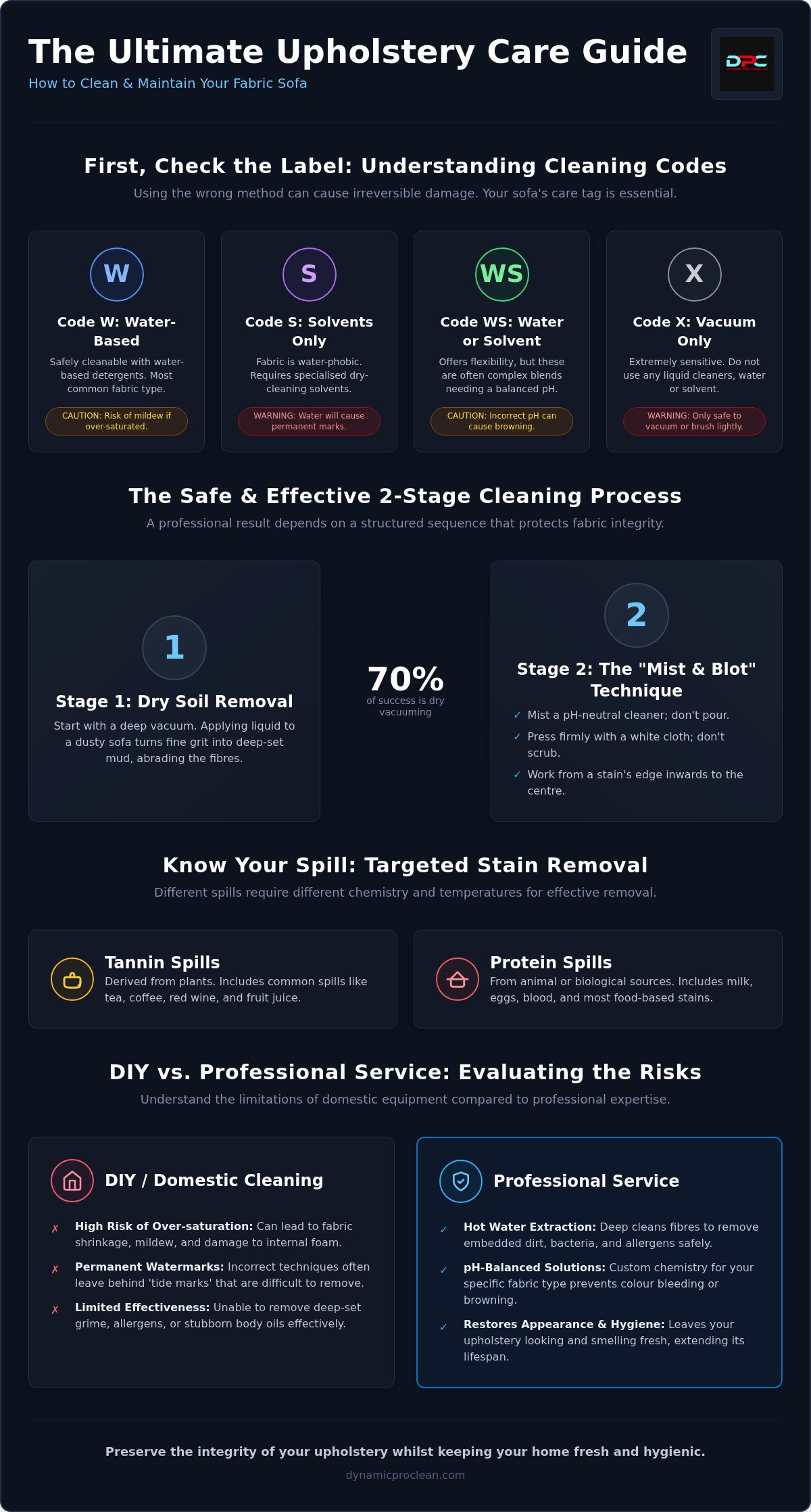
Industry standards categorise care into four primary codes: W signifies water-based cleaning, S denotes solvent-based methods, WS allows for either approach, and X indicates that only professional vacuuming or brushing is safe.
- Code W: These fabrics are the most common and can handle water-based detergents. However, over-saturation remains a risk, as it can lead to mildew or structural damage to the internal foam.
- Code S: Fabrics marked with an S are water-phobic. Using a standard household cleaner on these will often result in permanent "tide marks" that ruin the aesthetic; they require specialised dry-cleaning solvents instead.
- Code WS and X: WS fabrics offer flexibility, but they're often complex blends that require a balanced pH to prevent browning. Code X is the rarest and most sensitive. These fabrics are easily damaged by any liquid, meaning an expert fabric sofa cleaning service is the only safe way to handle deep-seated grime.
Identifying Your Fabric Fibre
To check for colour fastness, perform a rub test. Dampen a white cloth with your chosen cleaner and gently press it against an inconspicuous area for thirty seconds. If any dye transfers to the cloth, stop immediately to avoid ruining the piece.
Velvet and chenille have a "pile" that can be easily crushed or flattened if scrubbed too hard. Flat-weave fabrics are tighter and more resistant to physical wear, but they can trap dust deep within the weave. Whilst microfibre is incredibly resilient against water-based spills, it has a high affinity for body oils and grease. This often results in dark, shiny patches on armrests that require specific degreasing agents to lift without damaging the polyester base.
The Step-by-Step Guide to Cleaning Your Fabric Sofa Safely
Cleaning your upholstery requires a methodical approach to avoid the common pitfalls of DIY attempts. Whilst it's tempting to focus solely on visible marks, a professional result depends on following a structured sequence that protects the integrity of the material. Many homeowners make the mistake of jumping straight to wet treatments, but the foundation of any successful clean is actually dry soil removal.
Stage 1: Dry Soil Removal
Thorough vacuuming accounts for approximately 70% of the cleaning job. Dust and grit are naturally abrasive; they act like tiny pieces of sandpaper that grind against fibres every time you sit down. If you apply liquid to a sofa that hasn't been properly vacuumed, you risk turning that dust into "mud" which then seeps deeper into the weave.
Use your vacuum's upholstery attachment to reach deep into the crevices and under the cushions where grit accumulates. For households with pets, removing hair is a priority before any moisture is introduced. A specialised rubber brush or even a slightly damp rubber glove can help clump stubborn fur together, making it easier to lift without snagging the delicate weave of the fabric.
Stage 2: Controlled Wet Cleaning
The "Mist and Blot" technique is your best defence against over-saturation. When you're ready to tackle stains, use a pH-neutral solution mixed with lukewarm water. Instead of pouring liquid directly onto the sofa, apply it as a fine mist. This keeps the moisture on the surface of the fibres rather than letting it soak into the internal foam padding.
- The Blotting Method: Always use a clean, white microfibre cloth. Press firmly but do not scrub.
- Outside-In: Work from the outer edges of a stain toward the centre. This prevents the spill from spreading and reduces the risk of leaving a permanent ring.
- Agitation: If the fabric has a thick pile like chenille, use a soft-bristled brush to gently work the foam into the fibres. This helps break down surface tension without causing pilling.
The most critical and often ignored phase is drying. Excess moisture is the primary cause of "cellulosic browning" and musty odours that linger for weeks. To ensure a fresh finish, use a fan or open windows to create a cross-breeze. If you're dealing with a particularly large piece or a sensitive fabric, seeking a professional fabric sofa cleaning service is often the safest route to ensure deep extraction. If you're unsure about the chemistry involved, our team at Dynamic Pro Clean Ltd can provide a bespoke assessment to restore your upholstery safely.
Targeted Stain Removal: Strategies for Common Household Spills
When a spill occurs, your immediate reaction determines whether the mark is a temporary nuisance or a permanent scar. The "Golden Rule" of upholstery care is simple: never rub, always blot. Rubbing creates friction that generates heat, which forces the liquid deeper into the weave and physically distorts the delicate pile. By using a clean, white absorbent cloth to blot, you utilise capillary action to draw the liquid out of the fabric and into the cloth instead of pushing it into the padding.
Understanding the chemistry behind the spill is equally vital for a successful result. Tannin-based stains like coffee, tea, and red wine are acidic and often require specific acidic rinsing agents to neutralise the pigments. Conversely, protein stains such as blood or milk must never be treated with warm water. Heat causes the protein to coagulate and bind permanently to the fibres, making them nearly impossible to shift. Cold water and a gentle touch are the only safe first responses for biological spills.
Emergency Response for Liquid Spills
For red wine or coffee, work from the outside of the spill inwards to prevent the liquid from migrating further across the cushion. Whilst many online guides suggest using white vinegar and bicarbonate of soda, we advise extreme caution. This combination creates a fizzy reaction that can sometimes help lift grit, but the abrasive nature of bicarb can damage silk or wool blends. Be wary of supermarket "stain removers" too. Many contain high-alkaline bleaching agents that can cause permanent colour loss, leaving a pale ghost of the original stain that even a professional fabric sofa cleaning service cannot fix.
Grease and oil-based marks from food or skin contact require specialised surfactants. These chemicals are designed to emulsify the oil, breaking it down so it can be lifted away from the fibre. Without these agents, the oil remains trapped, eventually oxidising and turning into a dark, sticky patch that attracts more dust.
Managing Pet and Biological Stains
Pet accidents present a unique challenge because of their chemical complexity. Standard detergents merely mask the scent, but enzymatic cleaners are essential to physically break down the urea and proteins at a molecular level. Without this intervention, the odour will return the moment the humidity in the room rises.
A common frustration for homeowners is "wicking." This occurs when a stain appears to have gone, only to resurface days later as the fabric dries. This happens because the spill has soaked into the backing or padding; as moisture evaporates, it pulls the remaining residue back up to the surface. Our team at Dynamic Pro Clean Ltd uses professional-grade extraction equipment to remove these deep-seated contaminants entirely. A professional fabric sofa cleaning service ensures a truly hygienic finish, removing the biological source of bacteria rather than just the visible mark.
DIY vs Professional Fabric Sofa Cleaning Service: Evaluating the Risks
Whilst supermarket hire machines are widely available, they often lack the vacuum power required for deep extraction. A professional fabric sofa cleaning service utilises industrial-grade Hot Water Extraction (HWE) which operates at precise temperatures and pressures. This ensures that dirt is lifted without drenching the internal structure of your furniture. We've seen many cases where DIY attempts have actually pushed grime deeper into the padding, making the eventual professional restoration more complex.
The science of cleaning is largely about balancing pH. Most household cleaners are highly alkaline, which is effective for cutting through grease but disastrous for certain textiles. Without the correct acidic rinse to neutralise the fabric, those alkaline residues stay behind. They act as a magnet for new dirt and can cause chemical burns on delicate natural fibres. Our specialists understand these nuances, ensuring every bespoke solution protects the long-term health of your upholstery.
The Dangers of DIY Over-Wetting
Excess water is the primary enemy of upholstery. When moisture lingers in the sofa foam, it creates an ideal breeding ground for mould and mildew. This is a frequent issue with domestic machines that lack the suction to pull liquid back out of the cushions. The resulting musty odour is often a sign of internal bacterial growth that is difficult to eliminate once it takes hold.
On cotton and linen blends, over-wetting frequently triggers cellulosic browning. This chemical reaction leaves unsightly brown or yellow stains as the fabric dries. For tenants, these avoidable mistakes are more than just an eyesore; they often lead to significant deductions from security deposits. Using a professional fabric sofa cleaning service mitigates these risks, providing the high-impact suction needed to leave fibres damp-to-the-touch rather than soaked.
The Value of Professional Expertise
Choosing a specialist provides peace of mind that comes from years of experience and full insurance coverage. We understand how carpet clean services and upholstery care go hand-in-hand to maintain a truly hygienic home. Industrial-grade equipment removes deep-seated allergens, pet dander, and dust mites that standard household vacuums simply cannot reach, significantly improving your indoor air quality.
Time is another critical factor. We use industrial air movers to accelerate evaporation, meaning your sofa is often dry and ready to use in a fraction of the time a DIY job would take. This prevents the fabric from sitting wet for the 24 to 48 hours typically seen with hire machines. If you're preparing for a move, checking our end of tenancy cleaning checklist can help you decide which items require our expert touch to secure your deposit. To ensure your furniture receives the care it deserves, contact our expert team for a bespoke cleaning plan today.
Professional Upholstery Restoration with Dynamic Pro Clean Ltd
Since our founding in 2016, Dynamic Pro Clean Ltd has operated on a simple philosophy: your furniture deserves more than a generic, one-size-fits-all approach. We've built our reputation as specialists in upholstery and fibre restoration by treating every sofa as a unique project. Whether you're a homeowner looking to refresh your living space or a landlord requiring a guaranteed deep clean, we act as your dedicated partner in property maintenance. Our methodology moves beyond surface-level aesthetics to address the structural health of your fabric.
Every fabric sofa cleaning service we provide begins with a rigorous inspection and testing phase. We identify the specific fibre blend and conduct dye-stability tests to ensure our bespoke cleaning chemistry won't cause the bleeding or shrinkage risks associated with natural materials. This methodical preparation is what allows us to deliver results that domestic attempts simply cannot match. We take immense pride in our craft, combining the stature of an industry leader with the personal touch of a local specialist.
Our Advanced Cleaning Technology
Our commitment to quality is backed by professional-grade equipment that significantly exceeds the vacuum power of supermarket hire machines. We utilise high-pressure extraction systems designed to remove grit and allergens from the very base of the fibre. This ensures a comprehensive clean that improves indoor air quality whilst restoring the fabric's original texture.
- Eco-Friendly Chemistry: We use biodegradable, family-safe detergents that are tough on stains but gentle on the environment. These solutions leave no sticky residue behind, preventing the rapid re-soiling often seen with high-alkaline DIY products.
- Industrial Air Movers: To get your lounge back in use quickly, we employ rapid drying techniques. Our industrial fans accelerate evaporation, ensuring your furniture is ready for use in a fraction of the usual time.
- Precision Soil Removal: Our high-impact suction pulls deep-seated contaminants out of the padding, not just the surface weave.
Booking Your Service
Securing a professional fabric sofa cleaning service should be straightforward and transparent. We provide free, detailed quotes that reflect the specific needs of your upholstery without any hidden costs. Before our technicians arrive, we recommend a quick clear-out of the immediate area around your furniture. We'll handle the heavy lifting of the cleaning process, including the careful movement of cushions and thorough agitation of the fabric pile.
Regular professional maintenance is an investment in the longevity of your home. By removing abrasive grit and neutralising oils every 12 to 18 months, you prevent the premature wear that leads to costly replacements. We're here to provide the expert guidance and technical mastery needed to keep your upholstery looking and smelling like new for years to come. Contact us today to discuss a bespoke solution for your home.
Restore Your Home’s Comfort and Freshness
Maintaining a clean and inviting living space shouldn't be a source of stress or confusion. By understanding your sofa’s specific care labels and mastering the "mist and blot" technique, you've already taken the first steps toward better upholstery care. However, deep-seated grime and complex stains often require a level of precision that only high-impact extraction and pH-balanced chemistry can provide.
Since 2016, Dynamic Pro Clean Ltd has acted as a dedicated partner for homeowners and tenants alike. Our expert technicians are highly trained in fabric identification, ensuring your furniture is treated with the exact bespoke solution it requires. We utilise professional-grade fibre restoration technology that far exceeds the capabilities of domestic hire machines, removing allergens and odours at their source.
If you're ready to see your upholstery look and smell like new again, Request a Free Quote for Professional Fabric Sofa Cleaning. Trusting a professional fabric sofa cleaning service gives you the confidence that your favourite furniture is in safe, capable hands. We look forward to helping you restore the beauty and hygiene of your home.
Frequently Asked Questions
How long does a fabric sofa take to dry after a professional clean?
A fabric sofa typically takes between 4 and 12 hours to dry completely after a professional treatment. This timeframe depends on the fabric’s density and the room’s ventilation. Whilst our industrial extraction equipment removes the vast majority of moisture, we recommend keeping windows open or using a fan to circulate air. This prevents any musty odours from developing and ensures you can get back to your favourite lounge spot as quickly as possible.
Can professional upholstery cleaning remove all types of stains?
Whilst we achieve remarkable results, no service can guarantee the removal of every single stain. Success depends on the type of fibre and whether the spill has already bonded with the material. Stains like ink or hair dye can be permanent if they've sat for too long. However, our expert technicians use advanced chemistry to lift even the most stubborn marks that domestic cleaners simply can't touch, often restoring pieces that seemed beyond hope.
Is it worth cleaning a 10-year-old fabric sofa or should I replace it?
If the structural frame and cushions are still in good condition, cleaning is definitely worth the investment. A 10-year-old sofa often hides its original colour under a decade of dust and body oils. Professional restoration is a fraction of the cost of a new suite. It’s a sustainable choice that breathes new life into your furniture, making it look and smell fresh for several more years without the expense of a replacement.
How often should I have my fabric sofa professionally cleaned?
We recommend a professional deep clean every 12 to 18 months for the average household. If you have young children or pets, you might find that an annual service is more appropriate to manage increased wear and tear. Regular maintenance is vital because it removes the abrasive grit that hides deep in the weave. This prevents the fibres from fraying prematurely, effectively extending the lifespan of your upholstery for years to come.
Are the chemicals used in professional sofa cleaning safe for pets?
Our cleaning solutions are specifically chosen to be safe for both pets and children once the fabric is dry. We utilise eco-friendly, non-toxic detergents that leave no harmful residues behind. It’s always best to keep your pets in another room whilst the cleaning is in progress and until the sofa is fully dry. This ensures they don't accidentally ingest any damp solution or track dirt back onto the fresh, clean fibres.
What is the difference between steam cleaning and dry upholstery cleaning?
Steam cleaning, or hot water extraction, uses heated water to flush out deep-seated dirt, whilst dry cleaning uses specialised solvents for water-sensitive materials. Most modern sofas benefit from the deep-cleaning power of extraction. However, delicate fabrics like viscose or certain velvets require the dry-cleaning method to prevent shrinking or texture damage. We always test your fabric first to determine the safest and most effective approach for your specific piece of furniture.
Can I use a carpet cleaning machine on my fabric sofa?
You should avoid using a standard carpet machine on your upholstery because the pressure is often too high for delicate furniture. These machines can easily over-saturate the internal foam, leading to mould growth or permanent watermarks. A professional fabric sofa cleaning service utilises specialised hand tools designed for the contours of a sofa. This ensures precision moisture control and powerful suction that a domestic carpet cleaner simply cannot provide.
Will professional cleaning help with my dust allergy?
Yes, professional-grade extraction removes deep-seated dust mites, pollen, and pet dander. These microscopic triggers settle deep within the fabric fibres where standard vacuuming cannot reach them. By choosing a professional fabric sofa cleaning service, you ensure these pollutants are physically extracted from your home. This significantly improves indoor air quality and provides a much more comfortable environment for anyone suffering from respiratory sensitivities or common household allergies.


