
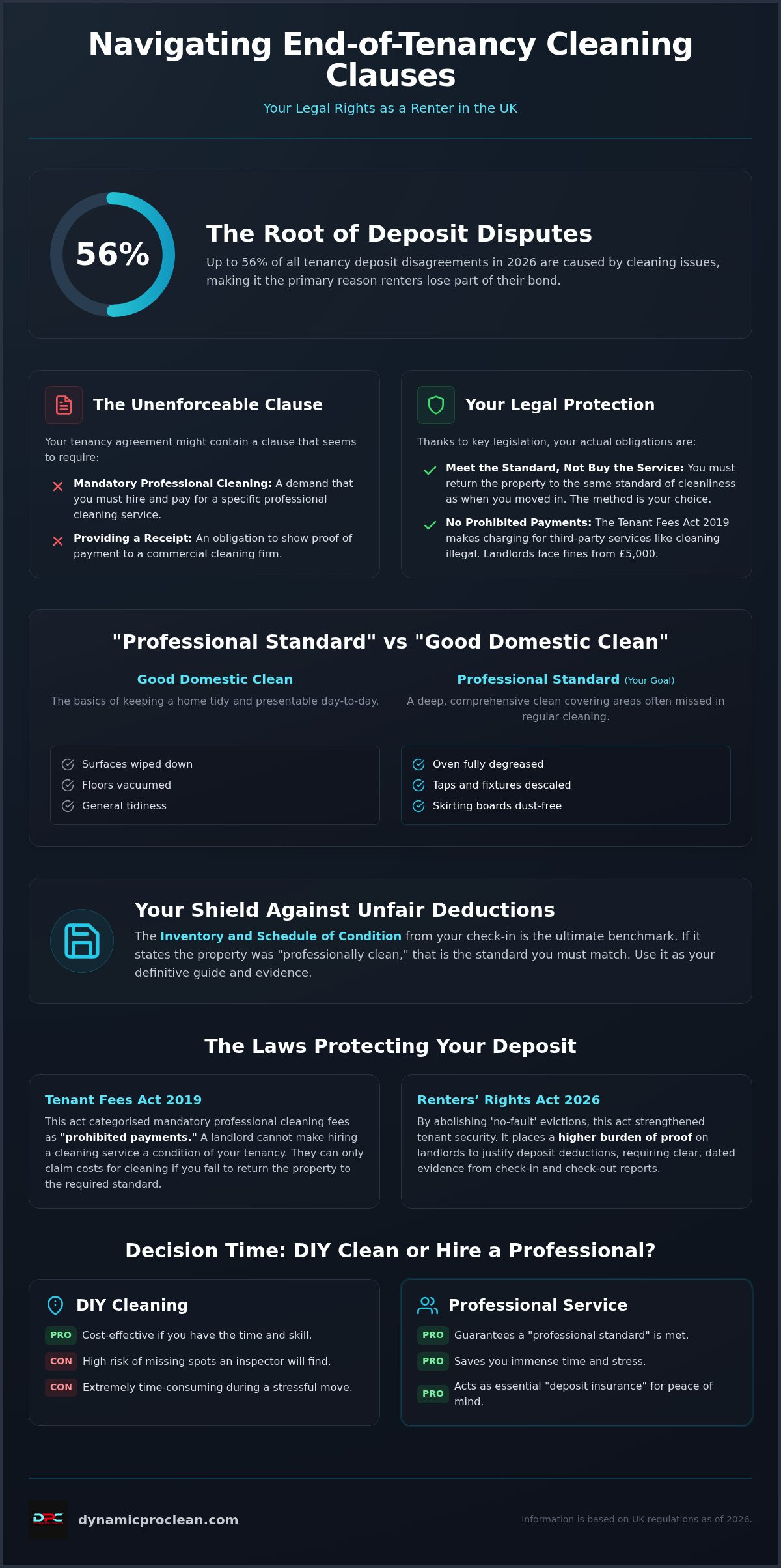
Did you know that cleaning issues remain the primary cause of tenancy deposit disputes in 2026, accounting for up to 56% of all disagreements? If you are currently packing boxes, that statistic likely mirrors the underlying stress you feel about your upcoming move-out inspection. It is incredibly frustrating to spend days scrubbing every corner only to worry that a landlord's personal preferences might still lead to a deduction from your security bond.
You may have noticed a professional cleaning clause in tenancy agreement paperwork you signed previously, but the legal landscape has changed significantly. Whilst landlords cannot legally force you to pay for a specific commercial service, they can absolutely demand the property is returned to a professional standard. This guide provides the clarity you need to distinguish between your actual legal obligations and unenforceable contract demands. We will explore how the Renters’ Rights Act 2026 impacts your move and provide a clear framework for passing your inspection. By understanding these rules, you can protect your money and ensure you leave your old home with your full deposit safely in your pocket.
Key Takeaways
- Learn why a mandatory professional cleaning clause in tenancy agreement documents is often unenforceable under the Tenant Fees Act 2019 and the Renters’ Rights Act 2026.
- Discover the crucial distinction between providing a professional receipt and meeting a "professional standard" of cleanliness to secure your full deposit return.
- Understand how to use your original check-in inventory as a shield against unfair deductions during the final move-out inspection.
- Identify the specific high-risk areas, such as ovens and carpets, that require specialist attention to satisfy the most rigorous landlord inspections.
- Gain a framework for deciding when to DIY and when professional cleaning serves as essential "deposit insurance" for a stress-free move.
Understanding the Professional Cleaning Clause in a UK Tenancy Agreement
Finding a professional cleaning clause in tenancy agreement documents is still a daily occurrence for many UK renters, despite major changes in the law. A cleaning clause is essentially a contractual promise about the state of your home when you hand back the keys. When you sign a Rental Agreement, you are agreeing to a specific set of rules that govern your stay and your departure. Historically, landlords often inserted aggressive terms requiring tenants to pay for commercial services regardless of the property's condition. However, legislative shifts have changed the game. Since the Tenant Fees Act 2019, it's been unlawful for landlords in England to force you to pay for a professional service. This doesn't mean you can leave a mess; it simply means the method of cleaning is your choice, provided you meet the required standard.
The baseline for this standard is always the Inventory and Schedule of Condition. This document, completed at the start of your stay, serves as the definitive record. If the inventory states the property was "professionally clean" upon arrival, that is the level you must match when you leave. Many landlords continue to use these clauses in their templates to ensure there is no ambiguity about their expectations, even if they can't legally demand a specific receipt from a cleaning firm.
The Standard "Professional Standard" Wording
Modern contracts often use specific phrases to define expectations. You'll frequently see a professional cleaning clause in tenancy agreement templates that mentions a "professional standard" rather than a "good domestic clean". There's a significant practical difference between these two terms. A good domestic clean generally means the house is tidy, surfaces are wiped, and the floors are vacuumed. A professional standard, however, implies a deep, comprehensive level of hygiene. This includes degreased ovens, descaled taps, and dust-free skirting boards. Understanding this distinction is vital because it's the benchmark used by deposit schemes to decide if a deduction is fair.
Why Landlords Still Include Cleaning Clauses
Landlords include these terms to protect their investment and maintain the property's long-term value. With the Renters' Rights Act 2026 now in full effect, the burden of proof for deductions has increased. Landlords can no longer rely on "no-fault" evictions, making the end-of-tenancy evidence much more critical. A clear clause provides a benchmark for Deposit Protection Scheme (DPS) adjudicators. It sets a transparent expectation for both the outgoing tenant and the incoming one, ensuring the property remains hygienic and habitable. For the landlord, it's about setting a high bar for property care that prevents the gradual decline of their asset over multiple tenancies.
The Legal Reality: Tenant Fees Act and the Renters’ Rights Act 2026
The legal framework surrounding your deposit has evolved rapidly. Since 2019, the Tenant Fees Act has categorised mandatory professional cleaning charges as "prohibited payments". This means that any professional cleaning clause in tenancy agreement documents that forces you to pay a specific fee or hire a specific firm is legally toothless. According to the official Tenant Fees Act 2019 Guidance, landlords cannot make these services a condition of the tenancy. If a landlord attempts to enforce such a charge, they could face significant fines from local authorities, often starting at £5,000 for a first offence. This legislation ensures that your money is protected from arbitrary charges that don't reflect the actual condition of the property.
The introduction of the Renters’ Rights Act in May 2026 has strengthened these protections further. By abolishing Section 21 "no-fault" evictions, the Act ensures that tenants aren't pressured into accepting unfair contract terms out of fear. Landlords now have a much higher burden of proof if they wish to claim money from your deposit. They must provide clear, dated evidence, such as check-in and check-out reports, to justify any deduction for cleaning. If they fail to do so, the new Private Rented Sector Landlord Ombudsman provides a clear, free path for you to challenge their behaviour. This shift puts the power back into the hands of the tenant, ensuring that disputes are settled based on facts rather than landlord "wish lists".
Is the Clause Unenforceable?
There is a vital distinction between an illegal clause and an unenforceable one. While a landlord can write whatever they like in a contract, the law overrides any term that contradicts your statutory rights. You cannot be forced to use a specific cleaning company or provide a commercial receipt. You have the legal right to clean the property yourself. As long as you return the home to the same standard of cleanliness recorded at the start of your tenancy, the landlord has no legal grounds to withhold funds. However, many tenants find that achieving this "professional standard" is harder than it looks without specialist equipment.
The Pet Policy Exception
Pet ownership is the primary area where the rules become more nuanced. Under the 2026 regulations, landlords are generally encouraged to be more pet-friendly, but they can require you to ensure the property is returned to a specific hygiene level to protect future occupants. If a pet has been present, a landlord might validly request that carpets are professionally deep-cleaned to remove allergens or potential pests. In these instances, choosing a guaranteed end of tenancy cleaning service acts as a safety net, ensuring you meet these higher standards without a dispute. Balancing your love for your pets with professional hygiene standards is the best way to ensure a smooth transition when you move.
"Professional Standard" vs Professional Receipt: The Crucial Distinction
The legal benchmark for any move-out is straightforward: you must return the property in the same state it was in at the start of your stay, allowing for fair wear and tear. However, even if a professional cleaning clause in tenancy agreement templates cannot legally force you to pay for a commercial service, it still sets a high bar for the final result. The term "professional standard" introduces a layer of subjectivity that often sparks conflict between tenants and landlords. Whilst you don't legally need to show a receipt to prove you cleaned the home, you do need to show results that match the initial inventory. DIY attempts often fall short because domestic products simply cannot achieve the same finish as industrial-grade equipment, especially in high-traffic zones or neglected corners.
Defining "Professional Standard" Cleanliness
When an inspector enters a property, they focus on specific areas that are notoriously difficult to clean. The oven, upholstery, and carpets are usually at the top of their list. It's a common misconception that a standard domestic vacuuming is equivalent to professional carpet cleaning. In reality, domestic machines lack the suction and heat required to remove deep-seated dirt and allergens from the fibres. Inspectors often perform a "white glove" test in kitchens and bathrooms, checking for limescale on the underside of taps, grease on the extractor fan filters, and dust on the very tops of door frames. If these areas are not spotless, the property has not met the professional standard expected in your contract.
The Evidentiary Power of a Professional Receipt
This is where the evidentiary power of a professional receipt becomes your strongest asset. When you provide documentation from a specialist company like Dynamic Pro Clean Ltd, you're offering concrete proof of due diligence. Adjudicators from the Deposit Protection Scheme (DPS) often favour a professional receipt over "before and after" photos, as photos can be misleading or poorly lit. A receipt confirms that a specific, high-level service was performed by experts using professional-grade tools. Choosing a guaranteed end of tenancy cleaning service also provides an essential safety net; if an inspector identifies a minor oversight, a reputable firm will return to rectify the issue at no extra cost. This guarantee effectively removes the subjectivity from the inspection, making it significantly harder for a landlord to justify a deposit deduction based on cleaning issues.
How to Evidence Your Cleaning to Prevent Deposit Deductions
Securing your deposit requires more than just hard work; it requires a robust paper trail. Whilst the professional cleaning clause in tenancy agreement contracts might be legally limited, it still serves as the landlord’s blueprint for the final inspection. To protect yourself, your first step must be a side-by-side comparison with your original check-in inventory. This document is the only benchmark that matters. If a stain was present on day one, you aren't responsible for its removal on day one thousand. By identifying these pre-existing issues early, you prevent them from being wrongly attributed to your tenancy.
Once you have identified the baseline, pinpoint the high-risk areas that inspectors habitually check. These include the grouting in the bathroom, the tracks of sliding doors, and the dust on top of radiators. As you clean, take high-resolution, time-stamped photographs of every room. Focus on the details that matter: the inside of the fridge, the sparkle of the taps, and the condition of the skirting boards. When it comes to the final walkthrough, don't be passive. Walk through the property with the landlord or agent and present your evidence if they raise a concern. If you want to ensure your property meets these exacting standards, you can book a guaranteed end of tenancy cleaning to remove all doubt.
The Oven and Carpet Challenge
The oven and the carpets are the two areas that account for the vast majority of deposit disputes. Shop-bought cleaners often struggle to remove carbonised grease or deep-seated dirt that has been trodden into carpet fibres over several years. Inspectors look for a "like-new" finish that is incredibly difficult to achieve with domestic tools. For a full breakdown of what is required to pass, refer to The Ultimate End of Tenancy Cleaning Checklist 2026. This resource will help you organise your efforts and ensure no corner is overlooked during your move.
Dealing with "Fair Wear and Tear"
It's vital to distinguish between a property that is dirty and one that is simply worn. Landlords cannot legally charge you for fair wear and tear, which includes things like faded paintwork, a slightly worn carpet pile in hallways, or minor scuffs from furniture that has been in place for years. A professional cleaning clause in tenancy agreement paperwork cannot override your right to live in the home. When communicating with your landlord, be firm but polite about these distinctions. If a carpet is clean but simply thin from years of use, that is the landlord's maintenance responsibility, not a cleaning failure on your part.
Why Professional End of Tenancy Cleaning Remains the Safest Strategy
Moving home is widely regarded as one of the most stressful life events, and the pressure of meeting a professional cleaning clause in tenancy agreement contracts only adds to the burden. Whilst we have established that you cannot be legally forced to hire a specific firm, opting for professional assistance remains the most effective way to remove subjectivity from the final inspection. A landlord's definition of "clean" can vary wildly from yours, but a professional receipt provides an objective benchmark that is difficult to dispute. When you weigh the cost of a specialist service against the potential loss of a four-figure security deposit, the investment often pays for itself in both financial security and peace of mind.
At Dynamic Pro Clean Ltd, we approach every property with the same level of dedication and professional pride that has defined our work since 2016. We understand that your deposit isn't just money; it's the capital you need for your next chapter. Our team uses industrial-grade equipment to reach the standards that domestic tools simply cannot touch, ensuring that every corner of your home stands up to the most rigorous scrutiny. This proactive approach allows you to focus on the logistics of your relocation whilst we handle the deep restoration of your living space.
The Specialist Advantage
Our methodology is rooted in the demanding world of professional military march-out cleaning. These inspections are the gold standard of UK property handovers, requiring a level of precision that few domestic cleaners can replicate. By applying these same exacting standards to civilian tenancies, we ensure that nothing is left to chance. We also offer professional exterior pressure washing to ensure the property's curb appeal matches the interior's hygiene. For those dealing with more significant property issues, our Professional House Cleaning: The Ultimate Guide provides deeper insights into intensive property restoration.
Securing Your Deposit with Certainty
Booking a service that specifically targets the professional cleaning clause in tenancy agreement paperwork is a tactical move for any savvy renter. It allows you to delegate the most physically demanding part of your move to seasoned specialists who know exactly what adjudicators look for. You shouldn't have to spend your final days in a property scrubbing ovens or steaming carpets amongst a sea of packing boxes. Instead, you can rely on our decade of expertise to handle the heavy lifting. Book your guaranteed end of tenancy cleaning today to ensure a smooth transition and the full return of your deposit.
Securing Your Deposit for a Stress-Free Move
Navigating the end of your tenancy doesn't have to be a gamble with your security bond. Whilst a professional cleaning clause in tenancy agreement contracts cannot legally mandate a specific provider, it does set a high bar for property restoration. By matching your efforts to the original inventory and documenting your results, you can confidently challenge any unfair claims. Achieving a true "professional standard" in high-traffic areas like carpets and ovens is often the deciding factor for adjudicators when reviewing deposit disputes.
Since 2016, our team has acted as a trusted partner for tenants across the UK, specialising in the deep restoration required to pass even the most rigorous inspections first time. You can guarantee your deposit return with our professional end-of-tenancy cleaning services, which include specialist oven and carpet care as standard. Let us handle the scrubbing whilst you focus on the logistics of settling into your new home. With the right support, you can close this chapter with total peace of mind and your full deposit safely in your pocket. We look forward to helping you make your next move a complete success.
Frequently Asked Questions
Can a landlord force me to pay for a professional clean in 2026?
No, a landlord cannot legally compel you to pay for a professional cleaning service in 2026. Under the Tenant Fees Act 2019, mandatory cleaning fees are classified as prohibited payments. Whilst a landlord might request a high level of cleanliness, they cannot dictate how you achieve it or which company you hire. If they try to force a payment, they risk heavy fines from local authorities for breaching rental regulations.
What happens if there is a professional cleaning clause in my contract?
If you find a professional cleaning clause in tenancy agreement documents, it is typically unenforceable if it requires you to pay for a service. However, the clause still serves as a benchmark for the condition you must return the property in. You should treat it as a description of the final result required rather than a mandate to hire a specific contractor or provide a commercial receipt.
Does "cleaned to a professional standard" mean I have to hire a company?
"Cleaned to a professional standard" describes the quality of the finish, not the person who performed the work. You are free to clean the property yourself to save money. However, you must ensure every surface matches the condition documented in your original check-in inventory. If your DIY efforts don't reach that high level of hygiene, the landlord may then be entitled to claim for the cost of rectifying the mess.
Can a landlord deduct cleaning costs from my deposit automatically?
Landlords cannot automatically deduct money from your security bond for cleaning. They must provide clear evidence that the property's condition has deteriorated beyond fair wear and tear since you moved in. Any proposed deduction must be justified with photos or inventory reports. If you don't agree with the charge, you can use the dispute resolution service provided by your government-approved deposit protection scheme to challenge the claim.
How does the Renters’ Rights Act 2026 affect cleaning disputes?
The Renters’ Rights Act 2026 has significantly increased the burden of proof for landlords during deposit disputes. Since "no-fault" evictions have been abolished, landlords must rely entirely on documented evidence to justify any claims. The Act also introduced a new Private Rented Sector Landlord Ombudsman, which gives you a clearer and more accessible route to challenge an unfair professional cleaning clause in tenancy agreement disputes if your landlord behaves unreasonably.
Is a professional oven clean mandatory for a tenancy end?
A professional oven clean isn't a universal legal requirement, but it's the most common area for deposit deductions. If the oven was spotless and free of carbonised grease when you arrived, you must return it in that exact state. Standard domestic sprays often fail to reach the "like-new" finish required. Many tenants choose a specialist service to ensure this high-risk appliance passes inspection without any difficult negotiations or financial penalties.
What evidence do I need to prove I cleaned the property to a professional standard?
To prove you've met the required standard, you need a comprehensive collection of evidence. Start with high-quality, time-stamped photographs of every room, focusing on high-risk areas like skirting boards and kitchen appliances. Keep your original check-in inventory as your primary reference point. If you decide to use a specialist firm, a formal receipt acts as powerful proof of due diligence that deposit adjudicators find very persuasive during a formal disagreement.
Can I be charged for carpet cleaning if I have pets?
Yes, pet owners are often held to a higher hygiene standard to ensure the property remains safe for future tenants. If you've kept animals, your landlord can reasonably expect the carpets to be deep-cleaned to remove allergens, odours, or potential pests like fleas. In these scenarios, a professional carpet and upholstery clean is often the most reliable way to satisfy the landlord's requirements and avoid a protracted dispute over your security deposit.


