

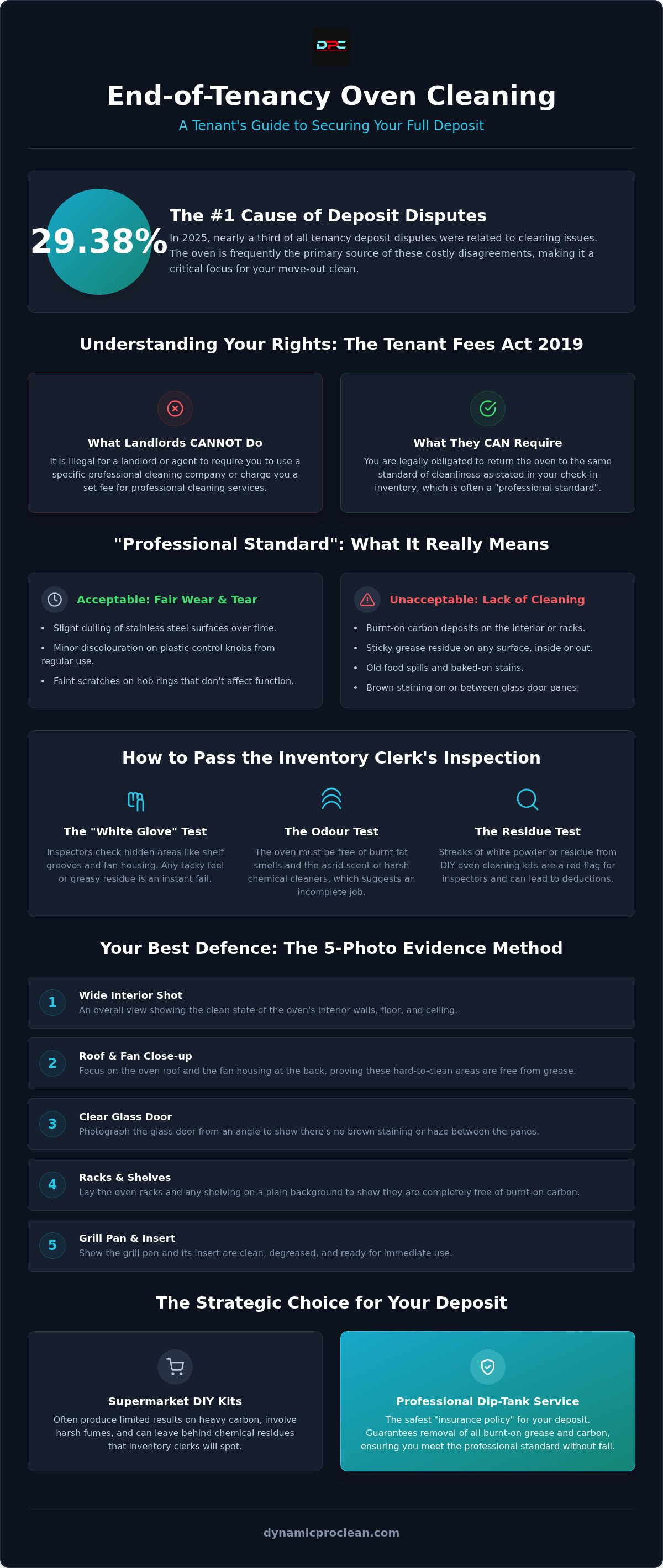
Did you know that cleaning issues accounted for 29.38% of all tenancy deposit disputes in 2025? It's a staggering figure that highlights exactly how much is at stake when you hand back your keys. If you're currently staring at a greasy glass door or layers of burnt-on carbon, you likely feel the pressure to meet the rigorous end of tenancy oven cleaning standards UK inspectors demand. It's completely natural to worry about losing hundreds of pounds over a single appliance, whilst the line between a "professional standard" and a "professional service" can feel blurred under the May 2026 updates to the Renters' Rights Act.
We believe that every tenant deserves a fair transition to their next home without the stress of financial deductions. This guide will help you master the exact inspection criteria, providing a clear checklist of what landlords look for and explaining the legal distinction between cleanliness and fair wear and tear. We'll give you the knowledge needed to ensure your kitchen appliances are spotless, giving you total confidence that your security deposit will return to your pocket where it belongs.
Key Takeaways
- Understand your rights under the Tenant Fees Act 2019, including why landlords cannot legally mandate a specific cleaning company whilst still requiring a professional standard of finish.
- Learn how to pass the inventory clerk’s "White Glove Test" by identifying the hidden grease traps and carbon deposits that often lead to deposit deductions.
- Master the specific end of tenancy oven cleaning standards UK inspectors use to evaluate glass doors, racks, and internal linings for a successful handover.
- Discover the 5-photo method for documenting your oven's condition to provide undeniable evidence against unfair cleaning claims during the move-out process.
- Recognise why professional dip-tank technology provides a superior "insurance policy" for your deposit compared to the limited results of supermarket cleaning kits.
The Legal Framework: Tenant Fees Act 2019 and Oven Cleaning
The Tenant Fees Act 2019 completely changed the relationship between tenants and landlords regarding cleaning expectations. Under this legislation, it's illegal for a landlord or letting agent in England to include a clause in your contract that forces you to pay for a professional cleaning service. Whilst this protects your wallet from mandatory fees, a common misconception is that it removes your responsibility to leave the property spotless. You're still legally required to return the oven to the exact same condition it was in when you first collected the keys, minus any genuine wear and tear.
This distinction between a "professional service" and a "professional standard" is where many tenants lose their money. You don't have to hire a company, but you do have to match the quality of work a specialist would provide. Because the oven is often the most neglected appliance during a tenancy, it remains the primary cause of deductions within the Tenancy Deposit Scheme. In 2025, cleaning issues were the leading cause of disputes, accounting for 29.38% of all cases, and the oven is almost always the centrepiece of those disagreements.
Cleanliness vs. Fair Wear and Tear
Understanding what counts as "fair wear and tear" is your best defence against unfair claims. In the kitchen, this covers things like slight discolouration of plastic control knobs or a faint dulling of the stainless steel surface over several years of use. It never covers burnt-on carbon, sticky grease, or old food spills. These are classified as a lack of maintenance rather than natural ageing. Your check-in inventory is the primary document here. If the report says the oven was "professionally clean" at the start, you must meet those same end of tenancy oven cleaning standards UK inspectors expect before you hand back your keys.
The Burden of Proof for Landlords
The legal burden of proof lies firmly with the landlord. They cannot simply claim the oven is dirty; they must provide evidence that the condition has deteriorated beyond fair wear and tear. This is why detailed, timestamped photographs from both the start and end of your tenancy are vital for your protection. To ensure you're fully prepared, your move-out evidence should include:
- High-resolution photos of the oven interior, including the roof and corners.
- Close-ups of the glass door showing a lack of "brown staining" between the panes.
- Clear shots of the grill pan, racks, and any internal shelving.
The professional standard is the benchmark for 2026 inspections, requiring the appliance to be free of all grease, carbon, and food debris regardless of the method used to achieve it. If you can prove the oven matches its original check-in state, the landlord has no legal grounds to withhold your funds.
The Inventory Clerk Benchmark: What "Clean" Actually Means
Passing a move-out inspection requires more than a quick spray and a wipe. Independent inventory clerks are trained to look beyond the surface, focusing on the areas that daily cleaning often misses. When an inspector arrives, they aren't just checking if the oven looks tidy; they're looking for signs of "restoration." A common tool in their arsenal is the tactile "White Glove Test." This involves checking for sticky grease residue in hidden spots, such as the grooves of the shelf sliders or the back of the fan housing. If their finger comes away with a yellow tint or a tacky feel, the appliance hasn't met the necessary end of tenancy oven cleaning standards UK landlords expect.
Odour is another critical factor that many tenants overlook. An oven might look sparkling, but if it emits the smell of burnt fat or heavy chemical fumes when opened, it can still trigger a fail. In 2026, inspectors are increasingly vigilant about cleaning chemical residues. Streaks of white powder from supermarket "oven bags" or the acrid scent of caustic sprays suggest an incomplete job. According to the Tenant Fees Act 2019 guidance, you're responsible for returning the property in a state that allows for immediate re-letting. If the next tenant can't cook their first meal without the oven smoking from leftover residue, you haven't met the handover benchmark.
The AIIC Standards for Kitchen Appliances
The Association of Independent Inventory Clerks (AIIC) provides the gold standard for these inspections. They distinguish between a "Good Domestic Standard" and a "Professional Standard." Whilst a domestic clean might be acceptable for daily life, a professional standard requires the appliance to be "completely grease-free." This includes the extractor fan, which must be free of saturated filters, and the oven light, which should be bright enough to see through a crystal-clear glass door. If the benchmark feels daunting, booking an expert oven restoration can ensure every AIIC criteria is met before the clerk steps through the door.
Common Failure Points Amongst UK Tenants
Most inspection failures happen because of three specific areas. First is the "oven roof." Because it's difficult to see, tenants often ignore the carbonised splashes above the grill element. Second is the warming drawer or storage space beneath the main oven; these often collect crumbs and grease that clerks never miss. Finally, failing to clean the rubber door seals is a major red flag. These seals trap food debris and grease, which eventually leads to perishing. Ensuring these end of tenancy oven cleaning standards UK are met means looking up, looking down, and checking every crevice that isn't immediately visible at eye level.
Component-by-Component Standards for a Successful Handover
To navigate the end of tenancy oven cleaning standards UK inspectors rely upon, you must view your oven as a collection of individual zones rather than a single unit. Each component has its own benchmark for success. As outlined in the Tenant Fees Act 2019 guidance, the property must be returned to its original state, which means every rack, screw, and seal must be scrutinised. A common mistake is focusing only on the visible floor of the oven whilst ignoring the functional parts that an inventory clerk will check with a torch.
The fan assembly is a frequent "hidden" fail during move-out inspections. Grease accumulates behind the protective cover, eventually hardening into a thick sludge that hinders rotation and creates a smoke risk. An inspector will check that the fan spins freely and that the vents are clear of any sticky residue. If the fan sounds laboured or looks clogged, it suggests the appliance hasn't been maintained to a professional standard, regardless of how clean the rest of the cavity appears.
Glass, Seals, and Door Hinges
One of the most visible benchmarks is the oven door. It's not enough for the front to be shiny; you must address the "brown staining" that often leaks between the panes of double-glazed units. Most modern ovens allow you to safely slide out the inner glass for cleaning, which is essential to meet the end of tenancy oven cleaning standards UK landlords expect. Whilst you're there, check the rubber door seals. These should be supple and free of trapped crumbs or grease. Perishing or sticky seals are often flagged as avoidable damage rather than fair wear and tear. Finally, ensure the hinges operate smoothly without the "crunch" of grit or old, hardened grease.
Racks, Grills, and Internal Linings
The "No-Carbon" rule is the gold standard for wire racks. They should feel smooth to the touch, with no black, crusty deposits on the joints or corners. If your oven features catalytic (self-cleaning) liners, do not scrub them with harsh chemicals, as this destroys their specialised coating. Instead, ensure they are free of large food splashes and debris. Inspectors distinguish between stained metal, which shows permanent heat discolouration, and dirty metal, which possesses a tactile layer of grease or carbon that can be removed with effort. Your goal is to ensure the grill pan and trays are indistinguishable from their check-in condition, showing only the natural patina of age rather than a lack of care.
Actionable Guidance: How to Document Your Cleanliness
Once you've put in the hard work to meet the end of tenancy oven cleaning standards UK inspectors require, your next task is to create an undeniable evidence trail. We've seen many tenants perform a flawless clean only to lose part of their deposit because they lacked the proof to counter a landlord's claim. Documentation acts as your insurance policy. It ensures that your efforts are recognised and that any disputes are settled quickly in your favour.
The most effective way to protect yourself is the "5-Photo Method." Before you hand back the keys, take five specific high-resolution images of the oven. Start with a wide shot of the appliance with the door closed to show the overall exterior. Follow this with a clear shot of the internal cavity, specifically angling the camera to show the roof and the back fan housing. The third photo should focus on the racks and grill pan, whilst the fourth must capture the glass door's transparency. Finally, take a close-up of the door seals and hinges. Perform this final documentation 24 hours before your inspection, ensuring no one uses the appliance after the photos are taken.
Preparing for the Final Walkthrough
We always recommend being present for the final inventory check if your landlord or agent allows it. This gives you the opportunity to address any minor issues on the spot. If an inspector points out a small smear of grease you missed, a quick wipe with a microfibre cloth can resolve the matter immediately, preventing a formal deduction. If you've opted for a professional oven cleaning, keep your physical or digital receipt ready to show the clerk. This document serves as a certificate of quality, proving that the appliance has been restored to a professional standard by experts. To ensure the rest of the property matches this high bar, you can book a guaranteed end of tenancy clean that covers every corner of your home.
Navigating Deposit Disputes (DPS and TDS)
If a landlord does attempt to claim part of your deposit for oven cleaning, the Deposit Protection Service (DPS) or Tenancy Deposit Scheme (TDS) will apply a "Reasonableness Test." Adjudicators in 2026 look for a fair comparison between the check-in report and the check-out condition. They won't allow a landlord to claim for a "professional clean" if the oven was only "domestically clean" when you moved in. By using a comprehensive end of tenancy cleaning checklist, you can demonstrate that you followed a methodical process to maintain the property. Your timestamped photos, combined with a detailed check-in inventory, provide the strongest possible defence against unfair deductions, ensuring your money stays where it belongs.
Professional Oven Cleaning: The Strategic Move for Tenants
Choosing to hire a specialist isn't just about saving yourself a dirty job; it's a strategic decision to ensure your deposit remains intact. Whilst supermarket sprays and "oven in a bag" kits might remove surface grease, they rarely touch the deep-seated carbon that inventory clerks hunt for during their inspections. Professional dip-tank technology allows us to strip every removable part, including racks, trays, and fan covers, and soak them in a heated solution that dissolves years of grime. This process achieves a level of restoration that domestic products simply cannot match, ensuring your appliance meets the most stringent end of tenancy oven cleaning standards UK inspectors apply in 2026.
The return on investment becomes clear when you calculate the cost of a potential deposit deduction versus the price of a professional service. Moving house is an exhausting transition, and spending four hours scrubbing a grill element is rarely the best use of your time. By delegating this task, you're effectively purchasing an insurance policy for your security deposit. You gain the peace of mind that comes from knowing the number one source of move-out stress has been handled by experts who take immense pride in their craft.
The Dynamic Pro Clean Difference
Since our founding in 2016, we've developed a methodology rooted in precision and reliability. We specialise in military march out cleaning, which represents the absolute pinnacle of UK inspection standards. If a clean can pass a rigorous military handover, it will easily satisfy any civilian letting agent or landlord. Our team uses eco-friendly, fume-free chemicals, meaning the oven is safe for immediate use, which is a critical factor for properties that need to be re-let the same day. With our transparent fixed-fee pricing, you can budget for your move with total certainty, avoiding any hidden surprises.
Final Steps to Secure Your Deposit
To provide a total solution for your handover, many of our clients choose to combine their oven restoration with professional carpet cleaning. This comprehensive approach addresses the two most common areas for deposit disputes simultaneously, leaving the property in a state that allows for immediate re-letting. Don't leave your finances to chance during the final walkthrough. Contact us today for a free, no-obligation quote and let us handle the heavy lifting. Take the first step toward a successful move and book your professional end of tenancy clean to secure your deposit with confidence.
Secure Your Deposit with Confidence
We've explored the legal nuances of the Tenant Fees Act and the specific zones inventory clerks scrutinise during a move-out. Understanding that you're responsible for a professional standard of cleanliness, regardless of who performs the task, is the first step toward a successful handover. By documenting your hard work with the 5-photo method, you build an ironclad defence against unfair deductions from your security deposit.
Mastering the end of tenancy oven cleaning standards UK inspectors demand ensures you aren't part of the 29.38% of tenants facing cleaning disputes in 2026. If the pressure of moving is already high enough, let us provide the ultimate insurance policy for your funds. Our team specialises in military-grade standards, ensuring your appliance passes even the most rigorous march-out inspection. With our transparent fixed-fee pricing and a pass your inspection guarantee, you can focus on your new home whilst we handle the grease.
Get a Free Quote for Professional Oven Cleaning
You've got the knowledge to succeed; now it's time to make your move as smooth as possible.
Frequently Asked Questions
Can a landlord force me to pay for professional oven cleaning in the UK?
No, your landlord cannot legally mandate that you pay for a professional cleaning service or use a specific company. This was established by the Tenant Fees Act 2019 and remains the law in 2026. You are only required to return the oven to the same level of cleanliness recorded in your initial inventory. If you can achieve that "professional standard" yourself, you've met your legal obligation.
What happens if I clean the oven but the landlord is still not happy?
If a dispute occurs, the landlord must provide clear evidence, such as inventory photos, to prove the oven is dirtier than at the start of the tenancy. You should use your own timestamped move-out photographs to counter their claim through a tenancy deposit scheme. Adjudicators will then decide if the landlord's request for a deduction is reasonable based on the evidence provided by both parties.
How much grease is "acceptable" for an end of tenancy inspection?
Technically, no amount of grease is considered acceptable if the appliance was clean when you moved in. Because grease is a hygiene issue and a potential fire hazard, it's never classified as fair wear and tear. To meet the end of tenancy oven cleaning standards UK clerks expect, every surface should be completely smooth to the touch and free from any tacky residue.
Do I need to clean the extractor fan filter to pass the inspection?
Yes, the extractor fan is a vital component of the kitchen inspection. A saturated or discoloured filter is a major red flag that suggests a lack of maintenance throughout the tenancy. You should either thoroughly degrease the mesh filters in hot, soapy water or replace the paper versions entirely to ensure the ventilation system looks pristine and functions correctly.
Is "Fair Wear and Tear" applicable to a dirty oven?
No, fair wear and tear does not cover dirt, grease, or burnt-on carbon deposits. These are maintenance issues that a tenant is responsible for managing. Wear and tear only applies to the natural effects of ageing, such as the slight fading of the numbers on the control knobs or minor heat-related discolouration of the internal metalwork over several years.
How long does a professional end of tenancy oven clean usually take?
A thorough professional restoration typically takes between two and four hours to complete. This duration allows for the deep-soaking of racks in a specialised dip tank and the meticulous removal of carbon from the internal cavity. Larger appliances, such as range cookers or double ovens, will naturally sit at the higher end of this timeframe due to their size.
Should I provide a receipt for professional cleaning to my landlord?
Whilst you aren't legally required to provide a receipt, doing so is highly recommended as a proactive measure. A receipt from a reputable specialist serves as a certificate of quality, proving that the end of tenancy oven cleaning standards UK inspectors look for have been met. It often discourages landlords from making frivolous claims against your deposit before the dispute process even begins.
What are the most common areas missed when DIY cleaning an oven for move-out?
The most frequent oversights are the oven roof, the area behind the fan housing, and the rubber door seals. Many tenants focus on the glass and the base but forget to look up at the grill element where fat splashes often carbonise. Neglecting these hidden zones is the fastest way to fail an inspection, as inventory clerks are specifically trained to check these crevices.


