

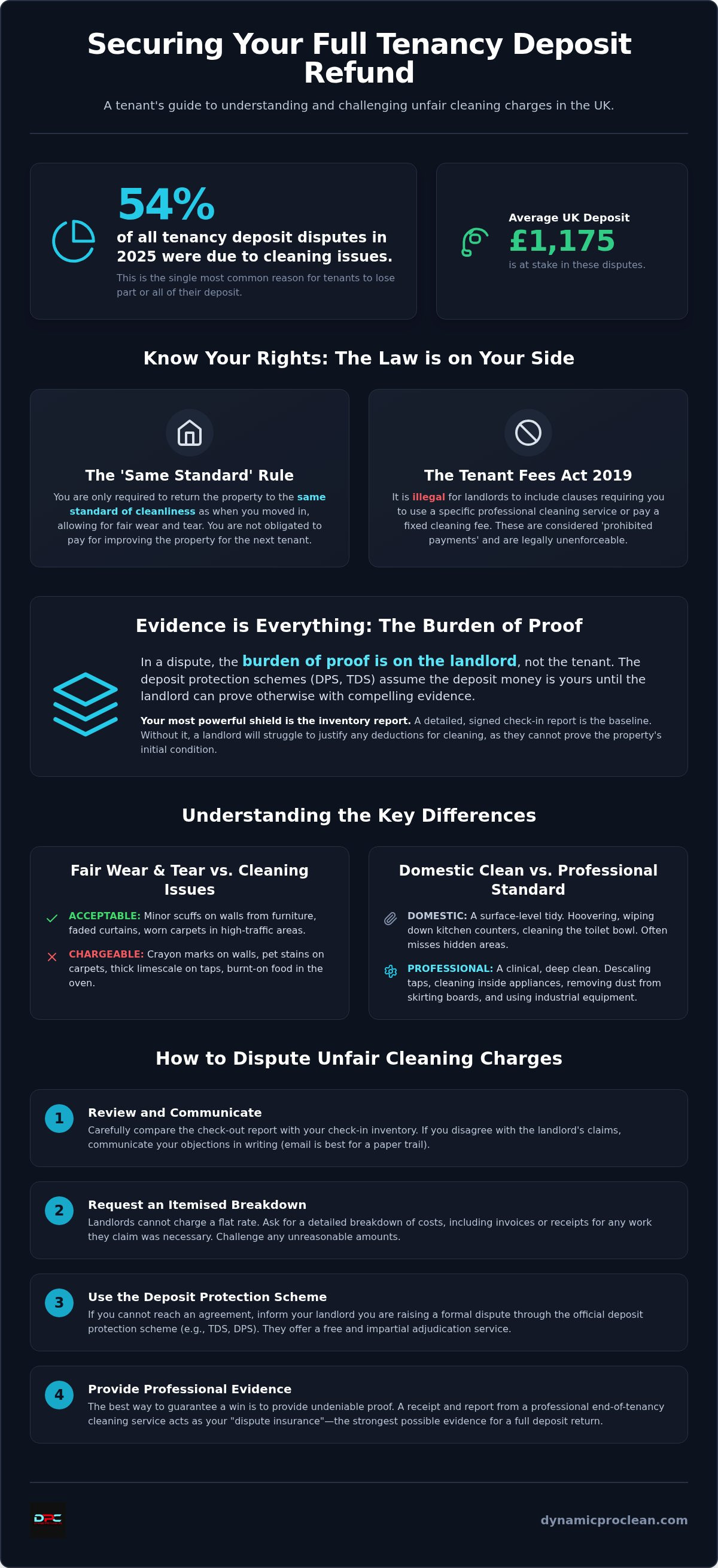
Did you know that cleaning issues accounted for a staggering 54% of all tenancy deposit disputes in 2025? It's a frustrating reality for many tenants who spent hours scrubbing floors only to face a landlord cleaning charges dispute just as they're trying to move on. You've likely felt that sharp sting of anxiety when a landlord demands a "professional standard" that feels impossible to define, especially with the average deposit now sitting at £1,175. It's easy to feel exploited whilst your hard-earned money is held back for minor issues that should legally fall under fair wear and tear.
As specialists who understand the rigours of rental inspections, we believe you shouldn't have to pay for a landlord's unreasonable expectations when you've already done your part. This guide will show you exactly how to challenge unfair deductions and use professional evidence to secure your full refund. We'll explore your rights under the Renters' Rights Act 2025, explain why "professional cleaning" clauses are actually unenforceable under the Tenant Fees Act 2019, and provide a clear roadmap for winning your case through official adjudication schemes like the DPS or TDS.
Key Takeaways
- Understand your legal rights under the Tenant Fees Act 2019, which ensures you only need to return the property to the same standard of cleanliness as when you moved in.
- Learn how to use inventory reports to shift the burden of proof back to the landlord and effectively challenge a landlord cleaning charges dispute.
- Identify the crucial differences between fair wear and tear and actual cleaning issues to protect yourself from paying for the natural deterioration of the property.
- Follow a clear, methodical resolution guide to handle disagreements, including how to request detailed cost breakdowns and when to involve deposit protection schemes.
- Discover why professional cleaning receipts act as a form of "dispute insurance" and provide the strongest possible evidence for a full deposit return.
Understanding Landlord Cleaning Charges: The 'Same Standard' Rule
Returning a property at the end of a tenancy often feels like a high-stakes balancing act. The central principle you must remember is the 'same standard' rule. Legally, you're only required to return the home in the same state of cleanliness it was in when you first collected the keys, allowing for fair wear and tear. If the property was professionally cleaned before you moved in, the landlord can expect it to be professionally cleaned when you leave. However, if the carpets were stained and the oven was greasy on day one, they cannot demand a showroom finish on your final day. This fundamental concept is at the heart of almost every Understanding Security Deposits case handled by UK adjudicators.
When a landlord cleaning charges dispute arises, it usually stems from a mismatch in expectations. You might feel the property is spotless, whilst the landlord sees every speck of dust on a skirting board. Understanding your rights is the first step in protecting your money. You aren't responsible for improving the property for the next tenant; you're only responsible for maintaining the condition documented at the start of your stay.
The Tenant Fees Act 2019 and Banned Fees
Since the Tenant Fees Act 2019 came into force, the landscape for renters in England has changed significantly. It's now illegal for landlords or letting agents to include clauses that force tenants to pay for a professional cleaning service as a mandatory condition. These are classified as 'prohibited payments'. If your tenancy agreement contains a clause stating you must pay a set fee of £200 for a check-out clean, that term is legally unenforceable.
Landlords cannot simply deduct a flat rate for cleaning without proving that the work was actually necessary. If your contract was signed before the 2019 Act, those old rules might have lingered for a transition period, but under the Renters' Rights Act 2025, all existing tenancies must now comply with current standards. If you spot an illegal 'set fee' deduction on your final statement, you have every right to challenge it immediately.
Defining 'Professional Standard' vs 'Domestic Clean'
There's a subtle but vital difference between a tidy home and a 'professional standard' finish. Whilst a domestic clean involves a quick vacuum and a wipe-down of surfaces, a professional end-of-tenancy clean is far more clinical. Adjudicators from schemes like the DPS or TDS look for specific evidence of deep cleaning in areas that are easily overlooked. This includes the total absence of limescale on taps, the removal of carbon deposits from oven interiors, and the extraction of deep-seated dust from carpet fibres.
A 'good effort' domestic clean often fails a professional inspection because it lacks the industrial-grade equipment needed for specialist tasks. To help you benchmark your own work and decide if you need expert help, we recommend using a detailed end of tenancy cleaning checklist. Using a structured guide ensures you don't miss the hidden spots, such as the top of door frames or the tracks of sliding windows, which frequently trigger a landlord cleaning charges dispute.
The Evidence Trail: Inventory Reports and the Burden of Proof
Winning a landlord cleaning charges dispute depends entirely on the quality of your paper trail. Many tenants mistakenly believe they must prove their innocence, but in reality, the burden of proof rests firmly with the landlord. They are the ones who must demonstrate that the property's condition has deteriorated beyond the fair wear and tear standards we discussed in the previous section. Without a clear, documented comparison between the start and end of the tenancy, a landlord will find it incredibly difficult to justify any deductions during a formal UK adjudication process.
In the UK, the deposit protection schemes operate on the principle that the money belongs to the tenant until the landlord proves a valid claim against it. This makes the inventory report your most powerful shield. If your landlord cannot produce a professional inventory report from the day you moved in, they'll struggle to prove that any "new" dirt or grime wasn't already present. This documentation serves as the baseline for every decision made by the TDS or DPS, ensuring that the process remains fair and evidence-based.
The Critical Role of the Check-in Inventory
Never sign a check-in inventory without scrutinising every detail. If the report says the kitchen is "clean to a professional standard" but you find crumbs in the drawers or grease on the extractor fan, you must document these discrepancies immediately. Add your own dated comments and photos to the report before returning it to the agent. If a landlord fails to provide an inventory at all, they are essentially flying blind. In the eyes of an adjudicator, no "before" evidence usually means no "after" deduction can be authorised.
Photographic Evidence: What the Dispute Service Needs
Photos are vital because they tell a story that words cannot match. When you're preparing to move out, follow the 'Golden Rule' of evidence: take high-resolution, time-stamped photographs of every single room. Adjudicators need context, so start with wide-angle shots to show the overall room condition. Follow these with close-ups of specific areas that are frequent targets for deductions, such as the inside of the oven, the tracks of sliding doors, and the space behind the fridge.
Don't forget the hidden spots that often trigger a landlord cleaning charges dispute. Open every cupboard, pull out the kitchen appliances, and photograph the skirting boards. Organising these photos into folders by room makes your case much more compelling if a dispute arises. If the prospect of documenting every nook and cranny feels overwhelming, booking a guaranteed end of tenancy cleaning service from Dynamic Pro Clean Ltd can provide you with a professional invoice that often serves as the ultimate piece of evidence for a full refund.
Fair Wear and Tear vs. Cleaning: Challenging Unfair Deductions
One of the most frequent flashpoints in a landlord cleaning charges dispute is the confusion between actual dirt and the natural deterioration of a property. Over time, every home shows signs of life. Carpets thin in high-traffic areas, paintwork fades under sunlight, and minor scuffs appear on skirting boards. These are all examples of fair wear and tear, and legally, you aren't responsible for paying to rectify them. Your landlord cannot expect you to return a property in better condition than it was when you moved in, especially if you've lived there for several years.
The length of your tenancy plays a massive role in what an adjudicator considers "fair." If you've occupied a flat for six months, a large stain on the carpet is likely your responsibility. However, if you've been there for five years, a certain level of thinning and dulling of the carpet fibres is entirely expected. Distinguishing between these subtle differences is the key to successfully challenging an unfair deduction from your deposit.
Calculating Depreciation and the Betterment Rule
A crucial concept often overlooked in these disputes is the "Betterment Rule." This rule prevents landlords from profiting by using your deposit to replace old items with brand-new ones. For instance, if you accidentally damage an eight-year-old carpet that was already near the end of its ten-year lifespan, the landlord cannot charge you for the full cost of a new replacement. They can only claim for the "lost value" of the remaining two years of that carpet's life.
Because replacement costs are so high, landlords often try to claim for a full replacement when a deep clean would suffice. In many cases, investing in professional end of tenancy carpet cleaning is significantly cheaper than fighting a heavy deduction. A professional receipt proves you've taken reasonable steps to restore the item, making it very difficult for a landlord to argue for a costly replacement during a landlord cleaning charges dispute.
Distinguishing Grime from Fair Wear and Tear
To win your case, you must be able to argue the difference between grime and age. Grime is something that can be removed with cleaning; wear and tear is permanent physical change. A sticky residue on a kitchen worktop is a cleaning issue. Conversely, a surface that has become dull or scratched through years of wiping is wear and tear. Adjudicators use industry standards to determine if a surface is "clean," even if it no longer looks new.
- Traffic lanes: Darker patches in the middle of a hallway are usually wear and tear caused by footfall, not dirt.
- Lightbulbs: Dust on a bulb is a cleaning task, but a flickering or blown bulb is a maintenance issue for the landlord.
- Paintwork: Fading or "ghosting" behind where a sofa sat is natural deterioration, whereas a large coffee splash is a cleaning failure.
By focusing on these distinctions, you can provide a logical rebuttal to any unfair claims. It's about showing that while the property might show its age, it's still clean to the required standard.
How to Dispute Cleaning Charges: A Step-by-Step Resolution Guide
Initiating a landlord cleaning charges dispute doesn't always require a formal legal battle. Most disagreements can be settled through clear, evidence-based communication before they ever reach an adjudicator. Your first step should always be an informal resolution. Reach out to your landlord or letting agent to discuss the deductions. It is possible they haven't seen your move-out photos or aren't aware of the specific cleaning you performed. A calm, professional conversation can often resolve "misunderstandings" without the need for third-party intervention.
If an informal chat doesn't work, you must demand a detailed breakdown of the costs. Landlords frequently provide "estimated" quotes from cleaning companies, but you have the right to see actual invoices for work already completed. They cannot simply guess a figure and hope you'll accept it. If they haven't actually spent the money on a professional clean, it becomes much harder for them to justify keeping your deposit money. This is the moment to gather your evidence bundle, including the time-stamped photos and inventory reports we discussed earlier, alongside any receipts for cleaning supplies or professional services you used.
Writing a Formal Rebuttal to Your Landlord
When informal talks stall, it's time to put your case in writing. Draft a professional, assertive email that clearly states why you disagree with the charges. Reference the Tenant Fees Act 2019 to remind them that mandatory "set fees" for cleaning are prohibited. Your rebuttal should be clinical and fact-based. For example, instead of saying "the kitchen was clean," write "the kitchen was returned in a condition that matches the check-in inventory dated 1st September, as evidenced by the attached photographs."
Politely but firmly ask for proof of cost for any proposed deduction. You should also set a clear deadline, typically ten days, for the return of the undisputed portion of your deposit. Landlords cannot legally hold your entire deposit hostage whilst you argue over a £50 cleaning fee. If you want to avoid this stress entirely, booking a guaranteed end of tenancy cleaning service provides you with a professional invoice that usually shuts down these arguments before they begin.
Navigating the Alternative Dispute Resolution (ADR) Process
If you cannot reach an agreement, you can raise a formal dispute through your deposit protection scheme’s portal, whether that's the DPS, TDS, or MyDeposits. This Alternative Dispute Resolution (ADR) process is free for tenants and involves an independent adjudicator reviewing evidence from both sides. It's a paper-based process, so the quality of your evidence bundle is everything. Adjudicators weigh conflicting evidence by looking for the most robust documentation; usually, a professional cleaning receipt or a detailed inventory will trump a landlord's handwritten notes.
Be aware that the adjudicator's decision is final and legally binding. A common mistake tenants make is failing to meet the strict evidence submission deadlines, which can lead to a lost claim by default. Once both sides have submitted their proof, the process typically takes between six to twelve weeks. Whilst waiting can be anxious, staying organised and providing a logical narrative of the property's condition will give you the best possible chance of a full refund.
Guaranteeing Your Deposit Return with Professional Cleaning Evidence
Whilst the previous sections have outlined your legal rights and the resolution process, the most effective way to prevent a landlord cleaning charges dispute is to remove any room for doubt. In the eyes of a deposit scheme adjudicator, a professional cleaning invoice is often viewed as the "silver bullet." It provides an objective, third-party verification that the property has been restored to a specific standard, which is far more persuasive than a tenant's own photos of their DIY scrubbing. When you present a professional receipt, you shift the conversation from a subjective debate about "how clean is clean" to a factual statement of work completed.
Investing in a professional end-of-tenancy clean offers a significant return on investment when you consider the cost of losing a full deposit. Moving home is a notoriously stressful period, and the hours required to reach a professional standard are often better spent organising your new property. Beyond the time saved, professional specialists use industrial-grade equipment, such as high-pressure steam cleaners and industrial carpet extractors, that achieve results DIY methods simply cannot match. These tools remove deep-seated carbon from ovens and allergens from carpet fibres, ensuring the property doesn't just look clean, but meets the rigorous technical standards required for a successful check-out.
Why Professional Invoices Trump DIY Effort
Adjudicators from the TDS or DPS value professional receipts because they list specific, high-intensity tasks. An invoice that explicitly mentions a "full oven deep clean" or "professional carpet restoration" carries immense weight. It signals to the landlord and the adjudicator that the property has been handled by experts who understand the "professional standard" definition. There is also a powerful psychological impact to presenting a professional certificate during the check-out. Most landlords and agents are far less likely to nitpick skirting boards or window tracks when they know a reputable company has guaranteed the work.
A professional guarantee is your ultimate safety net. If a specialist cleaner offers a "re-clean guarantee," it means that if the landlord identifies any legitimate cleaning issues during the inspection, the cleaners will return to rectify them at no extra cost. This effectively shuts down any justification for a deposit deduction, as the landlord cannot claim they need to hire their own cleaners to fix a problem that is already being handled under guarantee.
Organising a Pre-Inspection Clean
Proactivity is your best defence. It's always better to ensure the property is spotless before the landlord or clerk arrives for the final walkthrough, rather than reacting to a list of faults after you've already handed over the keys. By focusing on high-impact areas like bathrooms, windows, and kitchen appliances, you set a positive tone for the entire inspection. A sparkling oven and limescale-free taps often lead to a much smoother check-out process overall.
At Dynamic Pro Clean Ltd, we've spent years perfecting our methodology to ensure every surface meets the strict UK rental requirements. We don't just clean; we provide the documented evidence you need to protect your money. By combining our expertise with your understanding of the law, you can walk away from your old tenancy with your full deposit and your peace of mind intact.
Take Control of Your Deposit Return Today
Protecting your financial interests at the end of a tenancy requires a blend of legal knowledge and meticulous documentation. Throughout this guide, we've explored how understanding the betterment rule and maintaining a robust evidence trail can help you successfully navigate a landlord cleaning charges dispute. By focusing on the 'same standard' rule and distinguishing between actual grime and fair wear and tear, you place yourself in the strongest possible position to reclaim what is rightfully yours. You don't have to face the stress of move-out inspections alone or feel exploited by unreasonable demands.
If you prefer the absolute certainty that comes with expert intervention, choosing a specialist partner is the most effective way to safeguard your funds. You can secure your deposit with a professional end of tenancy clean from Dynamic Pro Clean Ltd. Our team delivers fixed-fee professional cleaning and specialist oven and carpet restoration, providing you with the evidence-ready invoices that adjudicators trust. Move into your new home with confidence, knowing that your previous property has been handled with professional pride and a dedication to quality. Let us take the burden of cleaning off your shoulders today.
Frequently Asked Questions
Can a landlord charge for professional cleaning if I cleaned it myself?
No, a landlord cannot legally insist on a professional service if you have already returned the property to the same standard of cleanliness documented at the start of your tenancy. Under the Tenant Fees Act 2019, clauses that mandate professional cleaning are unenforceable in England. If your own cleaning efforts match the move-in inventory, any attempt to deduct money for a professional contractor is likely to fail during a formal adjudication.
How much can a landlord reasonably charge for cleaning in the UK?
Landlords can only charge for the actual, proven cost required to restore the property to its original move-in condition. They aren't allowed to charge flat "penalty" fees or mark up the price for their own profit. Any deduction must be supported by a formal quote or invoice from a cleaning contractor. Adjudicators will only approve charges that are compensatory and proportional to the specific cleaning tasks that were missed.
What is the betterment rule in tenancy cleaning disputes?
The betterment rule is a legal principle that prevents landlords from ending up in a better financial or material position than they were at the start of the tenancy. In cleaning terms, this means they cannot use your deposit to pay for a deep clean if the property was only "domestically clean" when you moved in. They're entitled to the same standard, but they cannot use your money to upgrade the property's condition.
Can I clean the property myself to avoid landlord charges?
You are perfectly entitled to perform the end-of-tenancy clean yourself to save money. However, you must be meticulous and ensure every area, including the oven, extractor fan, and skirting boards, matches the check-in report. A landlord cleaning charges dispute often occurs when a tenant's domestic cleaning doesn't reach the "professional standard" required by the contract, particularly in properties that were professionally prepared before move-in.
What evidence do I need to win a cleaning dispute with my landlord?
The most vital evidence is a side-by-side comparison of the check-in inventory and the check-out report. You should also provide high-resolution, time-stamped photographs of the property on your final day, paying close attention to "problem" areas like appliances and carpets. Receipts for cleaning products or professional services you hired are also highly persuasive, as they provide objective proof of the actions you took to maintain the property.
How long does a deposit dispute take to resolve through the TDS or DPS?
Once you've submitted your evidence to the Alternative Dispute Resolution (ADR) service, the process typically takes between six to twelve weeks to reach a final decision. Whilst the law requires undisputed deposit amounts to be returned within 10 days of an agreement, a formal landlord cleaning charges dispute involves a thorough review by an independent adjudicator, which naturally extends the timeline for the final payment.
Is a landlord allowed to charge for cleaning the garden or driveway?
Yes, the "same standard" rule applies to the exterior of the property just as much as the interior. If you were provided with a tidy garden and a clean driveway, you're expected to return them in a similar state, allowing for seasonal changes. If the garden is significantly overgrown or the driveway is covered in oil stains that weren't there at move-in, the landlord can reasonably deduct the cost of professional pressure washing or gardening.
What happens if the landlord does not have a check-in inventory?
If a landlord fails to provide a professional check-in inventory, they'll find it almost impossible to win a cleaning dispute. Without a documented baseline, they cannot prove the property was cleaner when you moved in than when you left. In these cases, deposit scheme adjudicators almost always rule in favour of the tenant, as the landlord has failed to meet the necessary burden of proof to justify a deduction.


