
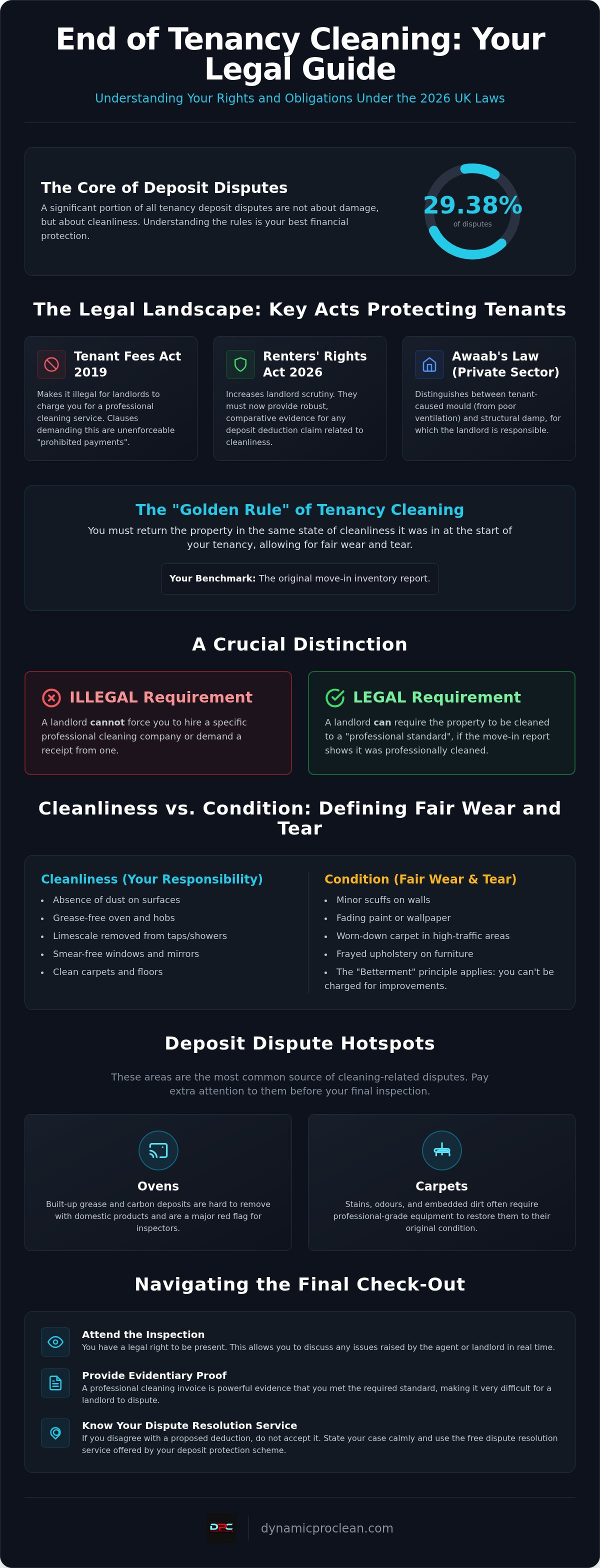
Did you know that 29.38% of all deposit disputes in 2025 were triggered by cleaning disagreements? With the Renters’ Rights Act 2026 now in full effect, mastering the end of tenancy cleaning legal requirements UK is no longer optional; it’s a vital part of protecting your finances. We know how stressful it is to manage a move whilst worrying about whether a landlord will find a reason to withhold hundreds of pounds from your security deposit.
It’s completely normal to feel confused about the distinction between fair wear and tear and a property that requires professional attention. This guide promises to give you total clarity on your legal rights and the high standards required for a successful check-out inspection in today's rental market. We will walk you through the 2026 legislative landscape, explaining why the evidentiary standard of your clean is the only thing that truly matters for a full deposit return. From understanding the ban on mandatory cleaning fees to documenting your property like a professional, you’ll gain the expert knowledge needed to move on with total peace of mind.
Key Takeaways
- Understand how the Renters’ Rights Act 2026 and the Tenant Fees Act 2019 protect you from illegal cleaning charges and arbitrary deposit deductions.
- Master the end of tenancy cleaning legal requirements UK to distinguish between fair wear and tear and hygiene issues that require professional attention.
- Learn why professional cleaning invoices serve as vital evidentiary proof to satisfy even the most rigorous inspection standards during a move-out.
- Discover why ovens and carpets remain the primary causes of deposit disputes and how to address these high-risk areas effectively.
- Gain practical strategies for the final check-out inspection, including your legal right to attend and how to handle disagreements on the day.
Understanding the Legal Framework: The Tenant Fees Act and 2026 Updates
The landscape of the UK rental market has shifted dramatically following the implementation of the Renters’ Rights Act on 1 May 2026. For anyone currently finishing an Assured Shorthold Tenancy (AST), understanding the end of tenancy cleaning legal requirements UK is the first step toward a stress-free move. We’ve seen many tenants feel pressured by complex contract wording, but the law is actually quite clear when you strip away the jargon.
Since the Tenant Fees Act 2019, it’s been illegal for landlords or letting agents to force you to pay for a professional cleaning service. This means they cannot write a clause into your contract that demands a receipt from a specific company as a condition of your deposit return. If such a clause exists, it’s generally considered a "prohibited payment" and is legally unenforceable. However, this doesn't mean you can leave the property in a mess. The "Golden Rule" still applies: you must return the home in the same state of cleanliness it was in when your tenancy began, minus fair wear and tear.
The Renters’ Rights Act 2026 has added a new layer of protection by introducing a national landlord database and abolishing "no-fault" evictions. This shift means landlords face much higher scrutiny when they attempt to make deposit deductions. They can no longer rely on vague claims of "dust" to withhold your money. Instead, they must provide robust, comparative evidence between the move-in inventory and the final check-out report to justify any claim.
The Legality of Professional Cleaning Clauses
While a landlord cannot force you to hire a cleaner, they can legally require the property to reach a "professional standard" of cleanliness. This is a subtle but vital distinction. If your move-in inventory states the property was professionally cleaned at the start, you’re legally obligated to match that high standard when you leave. You can choose to do this yourself, but if the result doesn't match the original evidentiary record, the landlord may then be entitled to deduct the cost of a professional clean from your deposit to rectify the standard.
Awaab’s Law and Damp Considerations in Move-Outs
In 2026, health and safety standards have become a primary focus in rental disputes. Following the expansion of Awaab’s Law into the private sector, there's a much clearer legal line between tenant-caused mould and structural damp. If you're moving out and notice mould, you shouldn't automatically assume it's your fault. Landlords are now legally required to address structural issues and poor insulation. You are only responsible for cleaning mould that has formed due to a lack of basic ventilation, such as failing to use extractor fans or opening windows whilst drying clothes indoors.
Cleanliness vs Condition: Defining Fair Wear and Tear in 2026
Navigating the distinction between a property that is "dirty" and one that is simply "old" is where many deposit disputes begin. When we talk about end of tenancy cleaning legal requirements UK, we must separate cleanliness from condition. Cleanliness refers to hygiene and presentation, such as the absence of grease in an oven or dust on a skirting board. Condition refers to the physical integrity of the property, such as the age of the floorboards or the state of the paintwork.
The Deposit Protection Service (DPS) defines fair wear and tear as the reasonable deterioration of a property and its contents that occurs through normal, everyday use. A fundamental rule in UK rental law is the "Betterment" principle. This legally prevents a landlord from expecting a property to be returned in a better state than it was when you moved in. If you moved into a flat with scuffed hallways, you are not responsible for repainting them to a pristine finish. Your only obligation is to ensure they are as clean as the day you collected the keys.
Several factors influence what qualifies as fair wear and tear. A tenancy that lasted five years will naturally show more signs of use than one that lasted six months. Similarly, a family of four with pets will exert more pressure on a property's fixtures than a single occupant. If you are ever unsure about a specific charge, consulting the official government guidance can provide the necessary legal backing to challenge an unfair deduction.
Calculating Fair Wear and Tear
Determining the lifespan of fixtures is essential for a fair move-out. For instance, most rental-grade carpets are expected to last between five and eight years. If a carpet is already seven years old, a landlord cannot legally charge you for a full replacement due to thinning or fading. However, they can charge for a professional deep clean if there are new, avoidable stains. Using our end of tenancy cleaning checklist allows you to track these areas methodically. If the thought of debating carpet lifespans feels overwhelming, many tenants choose a guaranteed end of tenancy cleaning service to provide an indisputable standard of hygiene.
The Importance of the Check-In Inventory
The check-in inventory is the most powerful legal document in any cleaning dispute. In 2026, deposit schemes rely heavily on high-resolution, time-stamped photography as primary evidence. If your original inventory was vague or inaccurate, you should have challenged it within the first few days of your tenancy. If you didn't, you must rely on your own move-in photos to prove the original state. Without this comparative proof, it becomes incredibly difficult to argue that a property was "already dirty" when you arrived.
The Evidentiary Burden: DIY Cleaning vs Professional Certification
Choosing between a DIY scrub and hiring a specialist is one of the most significant decisions you will make during your move. While it is perfectly legal to clean the property yourself, the end of tenancy cleaning legal requirements UK place a heavy evidentiary burden on the tenant. You must be able to prove that the property has been returned to the exact standard recorded in the move-in inventory, minus fair wear and tear. This is where many tenants struggle, as the "standard of proof" required by adjudicators is often higher than a standard domestic clean can provide.
Professional invoices act as a "certificate of compliance" in the eyes of letting agents and deposit schemes. When you present a receipt for professional oven cleaning, you are providing a form of "deposit insurance" that is incredibly difficult for a landlord to challenge. Without this, you run the risk of "double cleaning." This frustrating scenario occurs when a tenant spends days scrubbing, only for the landlord to decide the standard is insufficient and hire a professional team anyway. In these cases, you lose both your time and the cost of the cleaning from your deposit.
The Official Government Guidance for Tenants released in 2026 emphasises that any deductions must be reasonable and backed by evidence. A professional receipt is often the strongest piece of evidence you can submit to show you have fulfilled your contractual obligations to the highest possible standard.
What Constitutes "Professional Standard"?
Agents use a rigorous checklist that focuses on areas often missed during a regular clean. They will inspect inside every cupboard, pull out heavy appliances to check for dust, and run a finger along the tops of door frames and skirting boards. To meet the end of tenancy cleaning legal requirements UK, you generally need specialist equipment. Industrial steamers and high-grade degreasers achieve a level of hygiene that standard supermarket vacuums and domestic sprays simply cannot match. If the finish is not "restorative," it may not meet the professional standard expected in 2026.
Winning a TDS or DPS Dispute
If a dispute reaches the Tenancy Deposit Scheme (TDS) or Deposit Protection Service (DPS), the adjudicator acts as an impartial judge. They rely solely on the evidence provided by both parties. Tenants often lose these disputes because they lack time-stamped photos or professional receipts to counter a landlord's claims of poor hygiene. By submitting a professional invoice, you demonstrate that you have employed a specialist to meet the required standard. This shift in evidence makes it much harder for a landlord to justify further deductions, as the burden then shifts to them to prove that the professional clean was somehow inadequate.
Specialist Cleaning Requirements: Ovens, Carpets, and Outdoor Areas
While general dusting and hoovering are expected, the most frequent deposit deductions in 2025 stemmed from failure to meet specialist cleaning standards. To comply with the end of tenancy cleaning legal requirements UK, certain high-use areas require more than a standard domestic wipe-down. Landlords and agents focus heavily on the oven and carpets because these areas directly impact the hygiene and "ready-to-let" status for the next tenant. If these specific zones don't meet the evidentiary standard of the original inventory, you risk losing a significant portion of your deposit.
Deep Cleaning the "Heart of the Home"
Ovens are statistically the number one reason for deposit disputes in the UK. The legal standard for appliance hygiene is strict; they must be entirely free from grease and carbonised food. Standard supermarket sprays often fail to remove the burnt-on carbon that accumulates at the back of the unit. Investing in a professional oven cleaner ensures that the racks, glass, and even the extractor fan filters are restored to an inspection-ready state. Neglecting the hob or the greasy film on the extractor housing is a common mistake that leads to automatic cleaning charges from letting agents.
Floor Restoration and Pet Clauses
The Renters’ Rights Act 2026 has introduced significant changes regarding pet ownership in rental properties. While landlords must now consider pet requests reasonably, they can also require specific cleaning standards to mitigate allergens and odours. There's a vast difference between regular vacuuming and professional carpet cleaning. The law expects the removal of deep-seated dirt and biological traces, especially in properties where pets have resided. If a carpet is stained, simply "freshening it up" won't suffice; you're legally responsible for restoring the surface to its original hygiene level, provided it doesn't cross into the territory of betterment discussed earlier.
Exterior and Military Standards
Legal expectations often extend beyond the front door. If your tenancy agreement includes a garden, patio, or driveway, you're usually responsible for keeping these areas tidy and free from moss or oil spills. Our experience with military march out cleaning has taught us that these inspections are the most rigorous in the country. Adopting these "military grade" standards for your private rental ensures you leave no room for dispute. If your driveway is slick with grime or your patio is overgrown with weeds, a landlord may claim the cost of restorative pressure washing from your deposit. To ensure your outdoor areas pass with flying colours, consider our professional exterior pressure washing to secure your full deposit return.
Navigating the Check-Out Process: Your Legal Rights and Best Practices
The final day of your tenancy is often the most stressful, but it's also your most important opportunity to protect your money. Under the end of tenancy cleaning legal requirements UK, you have a clear right to be present during the final check-out inspection. We always recommend attending in person. It allows you to address any minor issues on the spot and ensures the landlord or agent doesn't record subjective "dirt" without you seeing it first. Never hand back your keys until you've taken a final set of time-stamped photos of every room, including inside the oven and cupboards. These photos are your final line of defence if a dispute arises after you've left.
The Check-Out Report vs The Inventory
A check-out report should never be a standalone document; it must be compared directly against your original move-in inventory. This comparison is vital for identifying what is a new issue and what was already present. If an agent tries to claim for something that was noted as "worn" or "dusty" at the start, they are essentially attempting "Betterment," which is legally prohibited. If you disagree with anything in the report, don't feel pressured to sign it without context. Instead, use the "Comment and Sign" strategy. Write your specific objections directly on the document before signing. This ensures your disagreement is legally recorded and prevents the report from being used as "undisputed evidence" in a tribunal.
Final Steps for a Smooth Transition
Achieving "vacant possession" involves more than just moving your furniture. You must ensure all rubbish is removed and all lightbulbs are in working order. Leaving a bag of bin liners or a few blown bulbs can technically give a landlord grounds to claim a "clearance fee." As a pre-emptive strike, provide your landlord with your professional cleaning receipt as soon as the work is finished. This signals that you have met the required standard and often discourages them from looking for minor faults. Booking your professional house cleaning well in advance of your move date helps you avoid last-minute stress and ensures the property is restored to its best possible state.
Remember the "10-day rule": once you've requested your deposit back, the landlord has 10 days to return it or notify you of any proposed deductions. If they miss this statutory timeline, you have a strong case to escalate the matter through your deposit protection scheme. By following these steps and mastering the end of tenancy cleaning legal requirements UK, you can move into your new home with your full deposit and your reputation as a tenant intact.
Take Control of Your Move and Protect Your Deposit
Navigating the end of tenancy cleaning legal requirements UK doesn't have to be a source of stress during your move. By understanding the distinction between fair wear and tear and hygiene standards, you've already taken the first step toward a successful check-out. Remember that the evidentiary burden rests on proving the property matches its original state, making high-resolution photos and professional receipts your most valuable assets. Whether you're tackling the oven carbon yourself or managing a complex military march-out, the goal is total compliance and a full deposit return.
If you'd rather focus on your new home whilst we handle the heavy lifting, we're here to help. Our team provides fixed-fee pricing with no hidden costs, ensuring you know exactly where you stand from the start. As specialists in high-standard military march-out cleans, we include comprehensive oven and carpet deep cleaning to satisfy even the most rigorous inspections. Secure your deposit with a professional end of tenancy clean from Dynamic Pro Clean Ltd and move forward with absolute confidence. Your peace of mind is our priority, and we're proud to be your dedicated partner in this transition.
Frequently Asked Questions
Can my landlord legally require me to pay for professional cleaning in 2026?
No, your landlord cannot legally force you to pay for a professional cleaning service under the Tenant Fees Act 2019. This legislation remains a cornerstone of the end of tenancy cleaning legal requirements UK. While they cannot demand a receipt from a specific company, they can legally insist that the property is returned to a professional level of cleanliness if that was the documented state when you moved in.
What happens if I clean the property myself but the landlord is not happy?
If your DIY efforts fail to meet the standard recorded in the move-in inventory, the landlord is entitled to deduct the cost of a professional clean from your deposit. They must provide evidence that your cleaning was insufficient and show the actual costs incurred to rectify it. This is why many tenants find that a professional, guaranteed service is a safer investment than risking a disputed deposit deduction later.
Is professional carpet cleaning a legal requirement if I had pets?
Under the Renters’ Rights Act 2026, landlords can legally require a professional carpet clean if you've kept pets in the property. This is designed to ensure that allergens, pet hair, and odours are thoroughly removed for the next occupant. While a standard vacuum might seem enough, it rarely meets the deep restoration standards required to satisfy a pet-related cleaning clause in a modern tenancy agreement.
How much can a landlord deduct for cleaning from my deposit?
A landlord can only deduct the reasonable cost required to restore the property to its original level of cleanliness, minus fair wear and tear. They aren't allowed to profit from these deductions or use them to upgrade the property. If they claim for a professional clean, they must provide you with a copy of the invoice or a formal quote from a reputable contractor to justify the specific amount being withheld.
Does fair wear and tear cover dirty carpets or a greasy oven?
No, fair wear and tear never covers hygiene issues like greasy ovens, limescale on taps, or dirty carpets. Wear and tear refers to the natural deterioration of the property over time, such as slightly scuffed paintwork or thinning carpet pile. If a surface is dirty, it's considered a cleaning failure rather than age-related damage. You're legally responsible for returning all fixtures in a hygienic and presentable condition.
What should I do if my landlord refuses to return my deposit due to cleaning?
You should immediately raise a formal dispute with your tenancy deposit protection scheme if your landlord refuses a fair return. All schemes, such as the DPS or TDS, offer a free dispute resolution service. You'll need to submit your move-in inventory, your final check-out photos, and any professional receipts as evidence. The adjudicator will then make a binding decision based on the end of tenancy cleaning legal requirements UK.
How long does an end of tenancy clean usually take to complete?
A comprehensive end of tenancy clean usually takes between four and eight hours to complete, depending on the size and condition of your home. Specialist tasks like restorative oven cleaning or deep carpet restoration often require additional time. If you're managing the move yourself, it's vital to schedule this work after your furniture has been removed but before the final check-out inspection to ensure the best possible results.
Do I need to provide receipts for cleaning to my letting agent?
You don't have a statutory obligation to provide receipts, but doing so is a highly effective way to prevent deposit disputes. A professional invoice serves as indisputable proof that you've met the required standard of hygiene. It acts as a pre-emptive strike against arbitrary deductions, as letting agents are much less likely to challenge a clean that's been certified by a reputable specialist with industry-grade equipment.


